A CAUSE FOR CELEBRATION
As she turns 80, Ailbhe Smyth hasn’t lost any of her political agency and unquenchable desire to right social injustice wherever she sees it. Tonie Walsh recently sat down with the activist to take stock of a full and noble life.
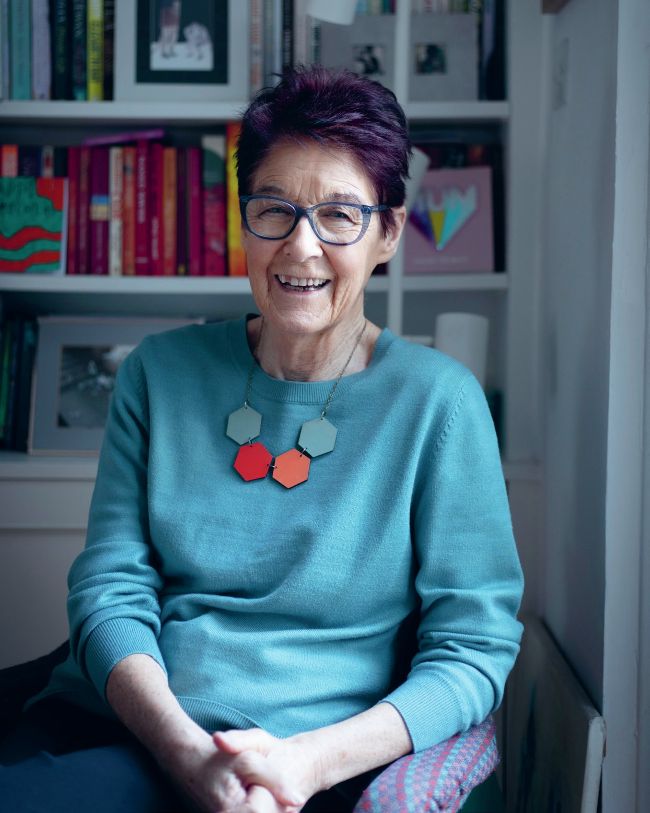
Photo by Hazel Coonagh.
The whole problem of lesbian invisibility – it’s a global problem. Therefore, it is also, if you like, a problem here in Ireland, and there are many different roots to that problem, but fundamentally it is rooted in the whole issue of gender power imbalance. And to think that that would somehow be absent also from our LGBTIQ community is nonsense. Of course it isn’t.”
Ailbhe, on a Zoom from Dublin, is mulling my observation of lesbian absences in Irish historiography.
“I mean, just like capitalism runs right through everything that’s in our community, so too does patriarchy, so too does colonialism. And, the way I put it to myself always, is that gender is a huge problem for women. And when we talk about gender, we usually are thinking more of women than of men. Men don’t think of themselves as having gender.”
I question whether that is for the same reason that many men are reluctant to consider themselves feminists, or don’t understand what the word feminism really means.
“Yes, well, the word ‘feminism’ is not very hard to understand. When people say ‘I don’t really know what that means’, I think to myself, ‘Well, you are either exceptionally stupid or very stubborn and determined’, because it’s not difficult.
“It is not difficult. It is about actually saying that gender has no place in differentiating between people in terms of our socioeconomic status or power or anything else. Gender should never be an important signifier any more than our sexuality should be an important signifier, any more than our chosen gender identity should be an important signifier, any more than the colour of our skin, any more than whether or not we have a disability.
“So we’ve all had these social factors that are not just about difference. They are about establishing and maintaining unequal systems of power between people. And they are never accidental. They’re always structural.
They’re always systemic.
“And gender is always in there. Sexuality is frequently in there. Ethnicity is in there. Age, by the way, let’s also not forget age.”
We’ll come back to that in a moment.
“But I mean, the whole gender question seems to me to be really incredibly interesting because I never tried to separate myself as the person I am. I never tried to separate out the feminism and the lesbian queer politics and the socialism and so on and so forth. I espouse all of those ways of thinking about myself and my politics.”
As she turns 80, Ailbhe seems to me the thriving embodiment of a distinct feminist-queer intersectionality. Regarded as one of Ireland’s most influential social change makers, TIME magazine named her in its 2019 list of ‘The world’s 100 most influential people’. In 2022, she received the Freedom of Dublin City, and last year, the French government awarded her the Légion d’Honneur, citing her lifelong career of “helping to transform the social fabric of your country and inspiring change far beyond its borders.”
It was in her role as my French tutor at University College Dublin (UCD) in 1978 that Ailbhe and I’s paths first crossed. I was on the cusp of coming out and throwing myself into the nascent Irish LGBTQ+ civil rights movement. Ailbhe would come out somewhat later in life, in her late 30s, but she was already cutting a swathe through the Irish feminist landscape.
In 1983, she set up the Women’s Studies Forum at UCD. “Notices went up around the university: ‘meeting of the Women’s Studies Forum in room D109, Tuesdays at one o’clock’. It wasn’t a formal programme... a series of meetings, conferences and seminars. We had a wonderful librarian, Monica Cullinan, who built up the library holdings in Women’s Studies, emerging from the women’s liberation movement. We didn’t talk so much about ‘gender studies’ until actually the late ‘90s.”
UCD’s current MA in Gender Studies is a much-lauded interdisciplinary course that focuses heavily on feminisms, sexualities, masculinities, and public policy. You can draw a line from it right back to the germinal Women’s Studies Forum of the mid-’80s, and yet its progression was not
inevitable.
“I left UCD in 1989 because I wanted to set up an actual Women’s Studies (academic) programme, and there was huge resistance. So I went off to Attic Press to work with Róisín Conroy, who was my girlfriend at the time.”
We’re talking about a period still smarting from the brutal 1983 abortion referendum; before decriminalisation of Victorian anti-gay laws and the advent of anti-discrimination and equality legislation; when lesbians and gay men were routinely denied promotional opportunities and protection of employment tenure. UCD’s governing body and many of its lecturers refused to officially recognise the college’s LGBTQ+ society over a 14-year period that lasted until 1990. Within this febrile cultural environment, the formal establishment of a Women’s Studies programme was, unsurprisingly, a bridge too far for some.
“Because it was seen as political. It was seen as revolutionary, rebellious. I mean, why was I never made a full professor in UCD?” Ailbhe questioned. In 2002, she lost a case at the Equality Tribunal alleging discrimination by UCD when she was passed over for an Associate Professor’s position. However, the tribunal did make a recommendation that UCD take specific measures to ensure gender balance on staff selection panels in the future.
After a year’s hiatus, Ailbhe returned to UCD and oversaw the establishment of a proper Women’s Studies postgraduate diploma through the Women’s Education Research and Resource Centre (WERRC). Its popularity and rapid growth would help seed the establishment of the Lesbian Lives conference in 1994.
“You cannot just keep all of this locked into the university; what you do in terms of knowledge has to move out and also be informed by what’s happening outside. So it’s this constant dialogue and conversation.”
With the participation of Lesbians Organising Together (LOT) and academics such as Ger Moane and Rosemary Gibney, Lesbian Lives would go on to become an academic and socio-cultural queer juggernaut and is justly revered by all who’ve sailed that ship.
In the intervening years, Ailbhe co-chaired the National LGBTQ+ Federation (NXF), was a founding member of Marriage Equality, Co-Director of Together for Yes and a trustee of Age Action Ireland.
We talk at length about the culture of caring in Ireland and how women are disproportionately impacted financially and socially by assuming the bulk of caring roles, but, conscious of how little time is left, we circle back to growing older and its impact for our queer society.
“Oh please, ageing. I just keep saying to my friends who are younger than me, including yourself, start training now, it’s really tough.
“We’re such a young community, our history is so recent. My generation is the first generation that’s growing old. We live in a profoundly ageist society. People don’t like to think about ageing because it’s about dying. There are strategies in place, but not all very good… and we are very reluctant to invest in creating the kinds of structures that we need to ensure the well-being of older people. I would love to see a ministry of care. The Nordic countries do it better, not perfectly, but there is a lot that we can learn.”
Conversations around sex and ageing – an almost taboo subject for some – seem to be shifting, especially in our rainbow community, I suggest.
“That’s only beginning to occur. As queer people, there should be nothing that stops and prevents us from exercising, enjoying and having our desiring, intimate, sexual lives. But what does stop us as older people are our living circumstances.”
How to square that circle should inform research and policy into ageing, not just for older queers with a specific set of socio-cultural needs, but also for elderly heterosexual women and men.
As we ponder the unhealthy state of democracy in our contemporary world, Ailbhe cautions about the ever-increasing need for a more empathetic collective consciousness in facing down marginalisation and othering. “One of the things we need to do as queers is to be even more determined to say it is not just about us; there are so many (other) marginalised people who are increasingly disadvantaged that absolutely have to get in there and benefit from change. When we talk about solidarity, we have to know what that means and we have to build it. Keep believing. Keep working.”
In celebration of Ailbhe’s 80th birthday, her close friend Patricia Carey shared the following message: “Ailbhe is a legend, friend and fellow activist, never short of unbounded energy, commitment, fearless leadership and inspiration. So many people in Ireland and beyond are so proud to know Ailbhe and bask in the benefits of all the achievements she has brought for us. Happy birthday to a wonderful warrior woman!”
Brian Sheehan, who served as Co-Chair of the NXF with Ailbhe and was her Co-Director at Marriage Equality, said: “Ailbhe is one of those unique people with indefatigable energy and drive, extraordinary personal warmth and care, who has a maximalist ambition for a fair, equitable and just world, but with a healthy dose of pushy pragmatism thrown in.
“Fearlessly, she has strategised, lobbied, cajoled, formed and led groups and alliances, and delivered frequent galvanising orations from protest stages that rouse people to action and remind us that our work is not yet done until everyone can enjoy the same rights and freedoms as ourselves. At 80, she remains an inspiration to us ‘young ones’, a path forger for activists young and old, and a vibrant example of how to make a difference in the world. In the midst of all that, she is great fun, sharply mischievous and a caring, thoughtful and loyal friend to very many.”
GCN would like to join Patricia, Brian and many others in wishing Ailbhe Smyth a very happy 80th birthday. Thank you for all of the work you have done and continue to do for LGBTQ+ people everywhere!