COPIED
9 mins

PUNK IN PRACTICE

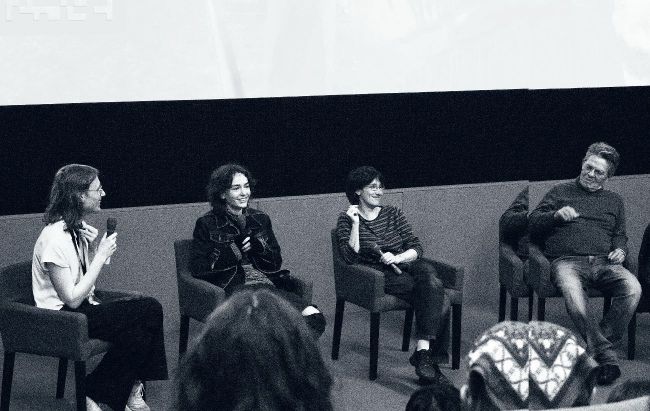
In April 2026, Jack Haven, Mina Walker and Peter Nolan Smith travelled to Dublin for theEuropean premiere of their film October Crow at the Trans Image/Trans Experience (TITE)Festival. Programmer and Guest Co-Ordinator Liadán Roche interviewed the trio after the screening and during a separate meeting in Outhouse, to learn more about the production and their filmmaking ethos.

Photo by Molly Phenom.

O ctober Crow is the directorial debut from Jack Haven, known to many from their role as Maddy in I Saw the TV Glow. The film follows a young woman who flees Kentucky for the bright lights of New York. There, she befriends James Steele, a benevolent fiend who names her Bella and introduces her to life as a dominatrix in a religious brothel run by La Bruja.

As stated by TITE, the film was born out of Haven’s friendships with leads Alexandra McVicker and Peter Nolan Smith, and is a largely improvised, earnestly kinky and unabashedly punk testament to the power of creative freedom and true love in a hostile world.

Haven had a set of guidelines for the film, which includes the cast and crew being around during the press cycle (dependent on availability). This meant that composer Mina Walker and actor Peter Nolan Smith were also present at the European premiere in Dublin, offering their insights alongside Haven.

Liadán Roche: Can you tell us about the origins of the film?\

Jack Haven: Yeah, so I moved into a building and Peter [Nolan Smith] was living upstairs as the super, and day one, he asked me if I would make a movie with him.

Like two years later, [Alexandra McVicker] moved to New York, she moved in with me. And Peter was very sick with liver cancer. Alex and I sort of had been dreaming of a movie that was about this orphanage for sex workers. We had big dreams for it, but when Peter ended up in the hospital and we felt like things were getting pretty serious, we were like, let’s just start making it now.

And so the first day we shot it, Peter was in hospital and we just started shooting on my phone. That’s not in the movie, but...

LR: Your one goal was to reach that feature length film mark, right?

JH: Yeah, every time we shot, I’d say, it has to be long enough, and we have to win a Palme d’Or! Those are the two requirements.

LR: What was a standard day of filming like for all of you

JH: Alex’s brother Austin died just before we made the film. We went to his funeral in Kentucky, and we shot the first scene that’s at the graveyard. We shot that like, right before the funeral.

We just happened to be hanging out with her friend, who plays the boy at the beginning. And I was like, “This is really awkward, but would you want to just shoot a movie right now?” And he was so sweet, and he was down for it.

A lot of the scenes would be like that. Some of them, Peter would have been texting me dialogue for months leading up to shooting. The exchange that ended up in the movie is: “Do you like sex?” “Yes.” “How many times have you had sex?” “Six.”

LR: I have a question for you, Peter, about James Steele as a character. What is the core truth of that character for you?

Peter Nolan Smith: I was living in Thailand, I had about five kids and two grandchildren there, with my wives. Somehow I picked up this name ‘James’, because somebody thought I looked like James Bond at the time, and my wives still think my name is James. I worked in nightclubs for a long time, wandered the world... It’s like James Steele was brought back to life. My wife still doesn’t know what my real name is.

LR: And Mina, I wanted to know a bit about the process of composing for this film. That was mostly improvised?

Mina Walker: Yeah. Jack was like, “I’m making this movie, and I want you to score it. We have to finish it in like, a week.” So we just met every day in (cocomposer) Avsha’s basement, we would watch a scene and just bust out a song for everything.

We were like, okay, you get a song, I get a song. We made one track for Jack. We’re like, “Okay, this is the like, raucous, sexy song,” and Jack just started spitting in a British accent. [Laughing] No offense to the British, but it was so fun to work that way.

It just felt fun to embody these characters, to be the sonic voices. I think that the way that we all sang was also a little bit different than the projects that we do in normal life. The movie was super DIY, so we wanted this music to sound very DIY and spontaneous.

LR: I’ve heard you use the word ‘punk’ in relation to October Crow . I really want to know what ‘punk’ means for you, in relation to the film, but also your own artistic practices.

JH: ‘Punk’ is the word I would use publicly, but in my own philosophy, it’s ‘waif ’. Waif Magazine was like an absurdist art magazine that we ran for six years, and ‘waif ’, the original dictionary definition, means “anything found without an owner”. I guess punk and waif is creating and adapting to a life that is unowned.

A lot of the work that I did when I was first coming up was super capitalist. I did a show for Nike that was like, how I first made money, and then I worked for Netflix, which is a tech company, so becoming more waif to me means like cutting out ownership of the work in order for the work to stay as honest and as fresh and as human as possible. MW: Punk is so much more about the core of something than the product of it. For everything I’ve done, I’ve felt like I didn’t know how to. Everything I’ve ever made with Jack, we’ve been collaborators for 14 years, has been waif and punk. We didn’t necessarily have all the resources or the skills or whatever, but we had this raw passion like, “We’re gonna make a band, we’re gonna make a movie!”

It feels like a punk movie. What Jack’s doing doesn’t feel like anything I’ve ever seen before. And they work with a $0 budget, and it’s really a $0 budget. It’s not like ‘low budget’ with $100,000. JH: Although I did pay Peter $250 for two days of work.

LR: Which two days did you pay Peter for?

JH: I don’t remember which two days, but there were two days when he just called and said, “Listen, I just, I mean, is there any money in this or?” And I was like, “Well, I mean, I can Venmo you?”

LR: Have any big takeaways from October Crow influenced the subsequent stuff you’ve been working on?

JH: There’s one Letterboxd review that really criticizes the sound. Then I saw Castration Movie Anthology II and in Castration II, there’s a 25 to 30 minute sequence–

LR: In the party, right?

JH: In the party! Where it’s so visceral, but you cannot hear what they’re saying other than like every three words, where Ivy Wolk is talking about how she was non-binary for four years in college. But it’s so funny that it almost doesn’t matter. So scratch that takeaway! The sound is actually fine.

Maybe the biggest takeaway is being gentle on the story. It doesn’t have to be too much, it doesn’t have to be too dramatic. Just let it play, let the characters fall in love, and you’ll fall in love.

I just want to have so much space for grief in all my work, because that’s what I want to make more space for myself, because there’s so much to grieve. There’s this great book by Martín Prechtel, he’s an indigenous writer, it’s called The Smell of Rain on Dust. It’s about grief as praise. I really believe that grieving deeply for something is a way to worship, pray, or to appreciate something. Like, what do we have left? Even the Palme d’Or, it’s like, it’s a joke, right? There’s nothing left to achieve. We’ve done it. We’ve stolen all the land, it’s over, you know? This way that we compete with each other, we have to untangle from that.

LR: To tie it back into TITE, I wanted to know what trans filmmakers influence you and your work as well.

JH: I’ll just say the trifecta to me, and I had a dream once that they were all looking at an iPad together, is Jane [Schoenbrun], Vera [Drew] and Louise [Weard]. There’s also Luis De Filippis, a Canadian filmmaker.

I actually haven’t seen Henry Hanson’s movie [Puppygirl], so I’m excited to see that. I’ve seen one of his shorts, which is awesome, but I’m excited to see the feature. Ava Hart is a young filmmaker who I know from New York. She has a really great short but she’s going to make a lot of work.

LR: People have also been coining the term ‘Trans New Weird’ for this new wave of trans film. I was wondering how you feel you relate to that?

JH: I think in a way, it conjures like a ‘Keep Austin Weird’ feeling, which, to me, is white supremacist. I feel like there is a white supremacist edge to ‘weird’.

I think what I notice about trans film, even the people that I’ve mentioned, are all white. I think there’s a belief that you can kind of sidestep accountability, or – all these words have lost meaning, because, like, Israeli PR firms use them – inclusivity, whatever, it’s all kind of weird.

But what are we avoiding when we keep our film circles white? I think in trans circles, that’s something to just kind of keep an ear out for. What are we not looking at? What do we want to protect? Ultimately, we want to protect our status. We want the Palme d’Or, right? Because we still believe in it, even if we say we don’t, even if we’re creating something new, what cycles are we repeating?

LR: More generally, I was curious what you think about October Crow being exhibited in a trans context, do you feel like this is a particularly trans film for you?

JH: To me, I understand trans filmmaking as inherently resistance filmmaking. Transness has always been a way to decode colonial ideas about identity. And I think that filmmaking is always a reflection of where we are culturally, and how we experience image, and how that image affects our relationship to our body.

And so I think October Crow was made sort of as a trans body of work, because it was invented for its own sake, for its own self-realization, and it was also invented in collaboration with Peter as he was dying. It was like we made the film as we were reinventing his body.

He got a new liver on Christmas Eve, about a year after we started shooting, and we were able to finish the film. So there’s a transition inherently in it.

This article appears in 393

Go to Page View
This article appears in...
393
Go to Page View
gcn
FROM THE TEAM
Keep up to date across our socials: @gaycommunitynews
Reflections on Pride
The National LGBTQ+ Federation (NXF), publishers of GCN, are pleased to have the opportunity to once again update readers on recent developments in the advocacy and policy space.
ROAST BATTLE ROYALE
Following last year’s record-breaking Roast of Panti Bliss , a night of comedy, fundraising, and one of the Abbey Theatre’s fastest-selling shows to date, GCN is giving the people what they want and bringing the Roast back this Pride, bigger and bolder with a fresh, hilarious cast and a brand-new format. Please welcome to the stage, GCN’s Roast Battle Royale !
FRIEND OR FOE?
What do you think of when you hear the words best friend, partner or family? Most of us probably imagine our real-life counterparts, but as Anna Vichtova points out, a rising fraction of society sees things very differently.
A placetobelong
As part of GCN and Belong To’s ongoing collaboration to platform a new generation of LGBTQ+ voices in Ireland, Séamus McDonnell highlights the importance of having physical community spaces.
RUN WITH PURPOSE
The Irish Life Dublin Marathon returns in 2026, and GCN is recruiting a new team of runners to take on the challenge, with only one spot still available! Five dedicated individuals have already been selected, prepared to take on the 42.2km race in support of Ireland’s free, independent LGBTQ+ media.
DRIVING THE CONVERSATION
Klinefelter syndrome, or XXY, is a common but largely unknown genetic condition in which a baby is born with an extra X chromosome. Often considered part of the intersex spectrum, Alice Linehan spoke to Gareth Landy, a campaigner passionate about raising awareness.
Bi us, for us
For years, ANNA Kerslake longed for a place that celebrated and normalised bisexuality. In 2023, she took matters into her own hands and created the BI-Monthly social group.
A MOTHER’S LOVE
As anti-trans rhetoric continues to appear in parliaments, courtrooms, and public spaces, what the community needs now more than ever is allies. Mammies for Trans Rights are a shining example, and Chris Rooke spoke to one of the co-founders about their essential work.
READ WITH PRIDE
Children’s Books Ireland is proud to champion diverse and inclusive storytelling that best reflects the vibrancy and diversity of modern Ireland. Each year, the team proudly curates a collection of LGBTQ+ books for readers aged 0 to 18 in the Read with Pride guide, 10 of which are spotlighted here.
Save the Date!
Empowering our identities
Earlier this year, ShoutOut released a new resource created by and for LGBTQ+ neurodivergent people. Recognising the importance of this work, Emmet Mc Ardle spoke to the team to find out more. Photos by Salvador Gutiérrez .
TEACHERS' GROUP
Art is for Everybody
There is a joke shared by me and
Send love
Sky
Meditations on labour
Shanaia Kapoor sat down with the Wexford-native to discuss everything from queerness to class, and the crux of meaning-making when you’re good with your hands.
Recovery as resistance
As society continuously perpetuates several harmful beauty standards, many people feel under pressure to control their bodies in different ways. Having previously dealt with an eating disorder, Megan Devaney explains how recovery can be a powerful form of resistance.
THE SEARCH FOR SAFETY
From June onwards, international protection processes in Ireland are undergoing serious reforms with the enactment of the International Protection Bill 2026, giving effect to the measures of the European Union Migration and Asylum Pact. Oisín Kenny speaks with community groups about the potential impact of this act, the growing disconnect between wider public attitudes and populist political movements, and the need to combat misinformation amid shifting social, digital and political landscapes.
TAKING ACTION
With decade-long waiting lists, invasive assessments and refusals of treatment, trans healthcare in Ireland is broken, and these issues are symptoms of an outdated, centralised, pathologising system. To fill the void in providing life-changing care, the trans community and healthcare professionals joined forces to create Kindred Clinic Cork, Ireland’s first peer-led trans health service pilot. Beatrice Fanucci spoke to the team to find out more.
LOVE IN A COLD CLIMATE
This August, in a town where polar bears roam wild and the dark season is months long, Longyearbyen Pride returns for a three-day celebration in the Norwegian High Arctic. To find out more about the world’s northernmost Pride, Charlie Hayward spoke to the team in charge.
RESIST & PERSIST
In 2025, dykes of all diversities, alongside those who love them, took back the streets of Dublin for the first time in over 25 years, and filled them with protest, power and joy. Now, they’re ready to do it all again, and Chairperson Alice Linehan shares what to expect.
MARCHING ON ON ON ON ON
Bodily autonomy has always been a core demand and theme for Trans & Intersex Pride Dublin. As Founder Ollie Bell points out, the group was formed in 2018 after the historic ‘Yes’ vote to repeal the Eighth Amendment, the constitutional ban on abortion.
ONE STORY MANY VOICES
Dublin Pride will host its annual festival this June, with a fabulous range of events taking place all across the city. The organisation’s Creative and Cultural Lead, Colm Molloy , shares further insights into the theme, branding, grand marshal and events for 2026.
A new approach
Following the liquidation of the company behind Cork Pride in 2025, a community group, Cork Community Pride, emerged to take the reins, centring grassroots organising and a community-based approach. Sarah Fitz spoke to one of the organisers, Niamh Kennedy, to hear about the plans for this year’s festival.
PRIDE CALENDAR 2026
The 2026 Pride season is well and truly
FAB FORTY
As The George marks its 40th anniversary, Sarah McKenna Barry caught up with some of the drag artists and DJs that call the iconic LGBTQ+ venue home, as they reflect on the bar’s long and fascinating history.
DO IT FOR THE DANCE
Mother Pride Block Party returns to Collins Barracks this June with a fabulous two-day celebration. Ahead of the unmissable event, Ailo James Kerr spoke to three of the lineup’s most exciting local DJs.
PLEASURE & POLITICS IN THE PIT
Pride parties are nothing without electrifying artists, and that’s the best way to describe the force of nature that is Peaches. Brian Dillon spoke to the Canadian hitmaker before she makes her return to Dublin with a DJ set at Mother Pride Opening Party, just weeks after her show at The Academy.
FINDING OUR RHYTHM
When two friends found a gap in Dublin’s nightlife scene for queer people of colour, they decided to create Aphrodisiac, a unique space championing representation and acceptance. Michaiah Johnson spoke to Co-Founder Jhonnie about the organisation, and why it is so special for so many people.
50 YEARS AT FULL THROTTLE
For five decades, Dykes on Bikes have used their presence as a marker of bravery, visibility, diversity and empowerment. Nicole Lee charts some of the group’s history and chats to the Melbourne chapter about the work they do.
Documenting care _in Dublin’s queer nightlife
Keelin O’Shea is a Dublin-born and Dublin-based documentary
Discover hidden histories and fresh perspectives!
THE BEAUTY OF OVERCOMING
James Mac is an internationally acclaimed makeup and drag artist, photographer, and hairstylist, with a background in sports and a passion for advocacy, making him quite the Renaissance human. Conor O’Doherty spoke to James while he was home in Laois, surrounded by signs of his heritage and upbringing.
your trash my treasure
SMUT Press is a London-based, Irish-run, queer publishing project and party platform. In coincidence with the release of their latest publication, Cruising Archaeology II: Eurotrash , Alice Linehan sat down with founders Jack Scollard and Jordan Hearns to learn more about their work.
Pride, pleasure & protection
Pride is a time of connection, celebration and community. As Pádraig Burke notes, for many, Pride also includes travel, nights out, meeting new people, reconnecting with chosen family, intimacy and sex.
PUNK IN PRACTICE
In April 2026, Jack Haven, Mina Walker and Peter Nolan Smith travelled to Dublin for the European premiere of their film October Crow at the Trans Image/Trans Experience (TITE)Festival. Programmer and Guest Co-Ordinator Liadán Roche interviewed the trio after the screening and during a separate meeting in Outhouse, to learn more about the production and their filmmaking ethos.
Tender Migrations
Queer Spectrum Film Festival returns in 2026 to showcase migrant and QPoC journeys through desire, transition and healing. To tell us more, Founder, Director and Programmer Pradeep Mahadeshwar dives into the programme.
Ag foghlaim le chéile
In July 2024, Ireland’s first Gaeltacht camp for LGBTQ+ adults launched in Cléire, off the coast of Cork. Spearheaded by AerachAiteachGaelach, the group’s director Eoin Mc Evoy is on hand to tell us more.
[Music Makers]
Electronic music has been a staple in LGBTQ+ communities across the globe since its inception. After all, as Nicolas Prince notes, the genre and many of its subgenres were pioneered by queer people, with creation stories rooted in the underground Black and Latin queer communities.
Directory
Dublin & The East Acting Out Performance group
Directory
Cork, Kerry & The South Choral Con Fusion
An almost forgotten history
Born in Sligo in 1870, Eva Gore-Booth was an Irish poet, theologian and dramatist, as well as a committed suffragist, social worker and labour activist. Sarah Creighton Keogh traces through her often overshadowed story, and her involvement with the Urania journal.
A CAUSE FOR CELEBRATION
As she turns 80, Ailbhe Smyth hasn’t lost any of her political agency and unquenchable desire to right social injustice wherever she sees it. Tonie Walsh recently sat down with the activist to take stock of a full and noble life.
THE FRONT LINES OF RESISTANCE
According to the Global Peace Index, Ireland is the second safest country on the planet. This is largely thanks to our longstanding commitment to military neutrality; something many of us consider to be a defining trait of our national identity. But as Kelly Earley points out, this could all be at risk.
The INMO wish you a Happy Pride 2026
FOR ALL YOUR CEREMONY NEEDS SEE YOU AT PRIDE ACROSS IRELAND!
FIGHTING FOR OUR FAMILIES
I t’s been 11 years since Ireland voted
Looking for back issues?
Browse the Archive >

Previous Article Next Article
393
CONTENTS
Page 104
PAGE VIEW