COPIED
8 mins

Meditations on labour

Richard Malone is an Irish artist whose work traverses sculpture, textiles, performance, and installation.

Shanaia Kapoor sat down with the Wexford-native to discuss everything from queerness to class, and the crux of meaning-making when you’re good with your hands.

R ichard’s practice interrogates gender, class, and identity through labour-intensive techniques, bringing attention to histories and practices often absent from museum collections. They have exhibited globally, including at MoMA and the MET in New York, the Royal Academy in London, and MoMU Antwerp, and have been commissioned for major institutional projects. Their writing, published in British Vogue, Luncheon, and Erotic Review, reflects a practice in which making and thinking are inseparable.

Richard is currently home in Wexford, so we speak over Zoom. I imagine they’re somewhere familiar. It’s the beginning of an Irish summer. We wave through the sunshine and introduce ourselves, presuming our acquaintance will be brief. Over the next hour, however, through some fairly long-winded questions, I come to know Richard as I would a new friend in the smoking room, like “Can I borrow a light?” except I’m picking their brain for some long-due respite amidst all the slop.

Richard is often based in Wexford. “A lot of the sculpture work is easier to make here because I have access to a welder and there’s more space.” It’s nice, they say, being back and ‘making’ in a rural setting. Everything in their practice welding, painting, plasterwork, stitching, sewing they learned from their grandmother, a hospital seamstress, and their father, a painter and decorator, all trades that continue to be present in Wexford today.

Home threads through all of Richard’s work without tipping into nostalgia. “Historically, I don’t come from a type of people whose work would be considered valuable,” they say, “so there’s an effort to make that really visible in anything I make.” They grew up with fixed ideas of Ireland being pushed at them, especially rural Ireland, the version that is quaint and quite Catholic. “When you grow up like that, people become fearful of the ‘other’, and being the ‘other’ is even worse.” Identity becomes enormously important when you come from a people colonised and overlooked for so long, but, they say, “I always feel like I have to reimagine it.”

Born in 1990, when being gay was still illegal in Ireland, Malone grew up as the country emerged from a violent past. Their work now reimagines the contexts in which it can exist, using their body as the primary tool. “I don’t know if I would’ve been able to make the work I make without the political changes Ireland has gone through. As my work grows, it’s about reimagining the context that it can exist in and how far it can be pushed.”

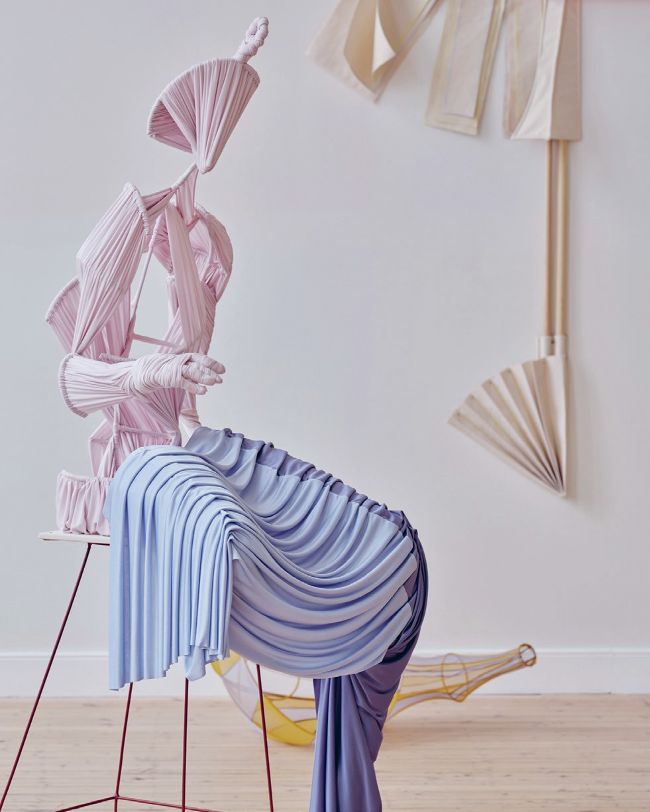
For Richard, bodies, labour, and identity are inseparable. Their practice brings together physical processes like welding and stitching, forms of labour that carry very different social histories. I ask if the contrast between softness and structure is a conscious choice. “Yeah, I think I struggle to understand what bits of my practice are conscious or unconscious,” they admit. “I think because of the history of queer identity, queer people have not necessarily been allowed to always be abstract or thoughtful. We’ve had to participate with our bodies in a way that’s really not abstract.” They reflect on the idea that something can be fragile. And it can also change. The idea that the work can change.
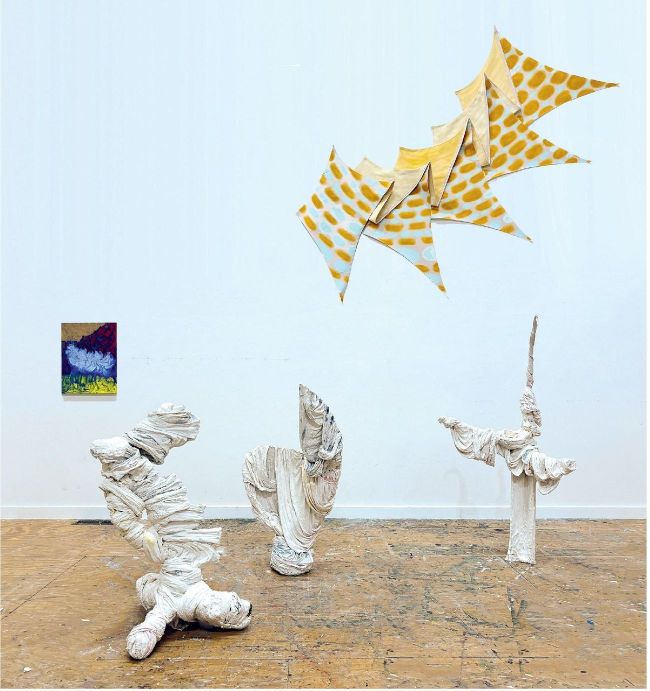
“I think labour carries such a specific connotation of class. And within that context are also the connotations of gender.” They recall the men working in factories as being quite reserved. “There’s no emotional language for things that happen on a factory floor.” By contrast, women in the domestic spaces of Malone’s childhood, “my aunts, my cousins, my grandmother, her friends,” spoke openly about politics. “As a young queer person, overhearing these conversations about divorce or the Marriage Referendum, the kitchen was an extraordinarily safe space. Gender didn’t dictate the ways you could engage.” It is precisely from this duality, between the reserved and the expressive, that Malone’s work emerges. “More than tension, I’m interested in the middle ground where something is not one thing or the other,” they say.

The closer Richard moves toward institutional spaces, the more sharply they seem to perceive the gaps within them. At the British School at Rome, they were brought into conversation with doctoral candidates from Oxford and Cambridge. “My questions were always just so different,” Richard recalls. “They’d say, ‘Well, this emperor was a patron,’ and I would respond, ‘But that’s not who built it, who was the person who built it?’” Richard fixes their hair, looking out of what I presume to be a window. “I see so many gaps. And the closer I am to those conversations in museums or places where serious cultural decisions get made, I’m immediately like, ‘Where are the queer people? Where are the working class people?’”

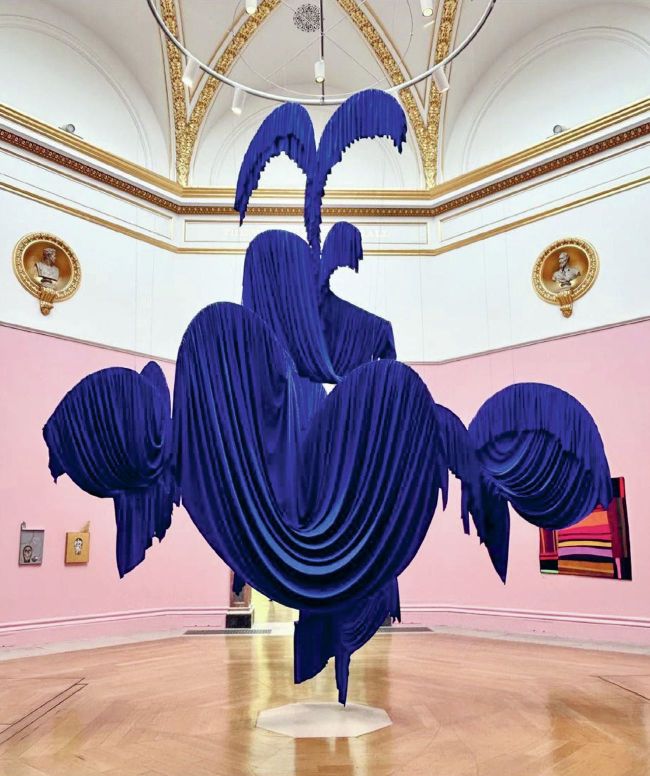
Malone was commissioned by the Royal Academy of Arts in London to create the Central Hall commission for their Summer Exhibition in 2023, showcasing a large-scale hanging sculpture, ‘poem in the dark about sadness/ filíocht faoi bhrón, as an dorchadas’ (above, left). It was the first time an Irish person had received that commission.

“I was super young and I never thought gender was that much a part of my work. But it’s a really big part of how I consider myself and question the world,” they say. Being in the beacon of art making in England, Malone notes, “It was so fascinating to observe all the female Royal Academicians being so friendly, ‘Oh, this is so exciting for us to see this massive sculpture in the middle of the room,’ while the male RAs were like, ‘Well, what is it?’ It seemed like such a threat to them. Something soft, suspended, constantly moving, refusing to reveal a front or a back or a side. Resisting what I’d call a product-y idea of art.”

When asked about the future of arts in Ireland, Richard says, “I think the next generation of artists may well be Irish, but they probably won’t be working and making in Ireland. Nothing would make me pay what it costs to live in Dublin. Which is sad because when I did a residency at the National Gallery and lived by Stephen’s Green, I thought, this could be hands down the best city. The people are amazing, everyone’s enthusiastic, 10 minutes and you see everyone you know. It’s really an infrastructure problem.
“I think class is a major barrier that nobody wants to talk about,” Richard continues. “Whenever I worked in museums in Ireland, people would say, ‘Oh, you’re from down the country,’ but I was like, ‘Your accents are actually really aggressive to me. You’re all talking to each other about a housing crisis that none of you are affected by. Like, you’re living in your mum’s house in Donnybrook.’ I’m like, is this bull? Ireland is quite left-leaning, but nobody wants to give up their spot. I’d happily advocate for grants and awards to be means-tested, and by means I’m talking also about what you stand to inherit, where you live, how you access money, how you make your work. People find that really uncomfortable.”

Richard and I kiki about the rental hellscape since the weather provides no grounds for complaint. “The Basic Income for the Arts came from a real need and years of research, but now it’s being implemented in a completely different country with completely different costs. Dublin has become unliveable. People aren’t asking for anything radical. Renovate the empty spaces above shops, make flats, make them affordable. The most rewarding exhibitions I’ve done have actually been outside Dublin, in places like Limerick and Leitrim, where people were just like, ‘f *ck it, do whatever you want, we’re here to support you.’ I owe a lot of that to Mary Conlon and Linda Shevlin who I worked with for my show at the Dock. There’s this assumption that radical work won’t connect outside Dublin, but honestly Dublin can be a conservative place sometimes.”

The preservation and reinvention of craft becomes more valuable when they’re in conflict with each other, “Here’s what it used to be, and here’s what it can become… Pre-colonisation Ireland was a matriarchal culture where power was handed down from woman to woman. And when I look at Irish art now, so many of the most brilliant artists are women, especially sculptors. Artists like Alice Maher, Dorothy Cross, Eileen Gray, Kathy Prendergast, Niamh O’Malley, Aleana Egan and Aideen Barry. They’re unbelievably brilliant thinkers who’ve reinvented craft and material in really political and sincere ways. By making their work, thinking differently, they opened the door for me to think differently too, or not to be afraid of a singular approach. I think they’re really instrumental in how they’ve rethought making, and seeing work like that is always an invitation to find your own language.”

I have to ask about their collaboration with Björk. “I’d done commissions with a lot of famous musicians,” Malone says, “but she’s the one that’s really significant to me. Her song ‘It’s Oh So Quiet’ – I think it was the first song I remember loving. I’ve never actually got to tell her that, but when we met, we had loads of similar interests.”

They reflect on the collaboration: “With Björk, it’s a sincerity thing. Sincerity has become almost icky now, but she’s really polite, loving, sensitive about things.”

Malone continues, describing the projects they made together – the album pieces, music videos, even her 50th birthday commission. “She was saying how Viking women escaped ships from Ireland to Iceland, and how music scores feel really similar between the two countries. Collaborating with her doesn’t feel like there’s any limit or expectation. I feel mad to be part of that family in some way.”

Our conversation ends here. Richard congratulates me on my graduation from Ivory Tower University, and we wave goodbye as the sun sets outside our windows. I shut my laptop and put on Björk’s ‘Venus as a Boy’ thinking maybe good art is only made when sincerity survives the process. My sense is Richard knows this well.

This article appears in 393

Go to Page View
This article appears in...
393
Go to Page View
gcn
FROM THE TEAM
Keep up to date across our socials: @gaycommunitynews
Reflections on Pride
The National LGBTQ+ Federation (NXF), publishers of GCN, are pleased to have the opportunity to once again update readers on recent developments in the advocacy and policy space.
ROAST BATTLE ROYALE
Following last year’s record-breaking Roast of Panti Bliss , a night of comedy, fundraising, and one of the Abbey Theatre’s fastest-selling shows to date, GCN is giving the people what they want and bringing the Roast back this Pride, bigger and bolder with a fresh, hilarious cast and a brand-new format. Please welcome to the stage, GCN’s Roast Battle Royale !
FRIEND OR FOE?
What do you think of when you hear the words best friend, partner or family? Most of us probably imagine our real-life counterparts, but as Anna Vichtova points out, a rising fraction of society sees things very differently.
A placetobelong
As part of GCN and Belong To’s ongoing collaboration to platform a new generation of LGBTQ+ voices in Ireland, Séamus McDonnell highlights the importance of having physical community spaces.
RUN WITH PURPOSE
The Irish Life Dublin Marathon returns in 2026, and GCN is recruiting a new team of runners to take on the challenge, with only one spot still available! Five dedicated individuals have already been selected, prepared to take on the 42.2km race in support of Ireland’s free, independent LGBTQ+ media.
DRIVING THE CONVERSATION
Klinefelter syndrome, or XXY, is a common but largely unknown genetic condition in which a baby is born with an extra X chromosome. Often considered part of the intersex spectrum, Alice Linehan spoke to Gareth Landy, a campaigner passionate about raising awareness.
Bi us, for us
For years, ANNA Kerslake longed for a place that celebrated and normalised bisexuality. In 2023, she took matters into her own hands and created the BI-Monthly social group.
A MOTHER’S LOVE
As anti-trans rhetoric continues to appear in parliaments, courtrooms, and public spaces, what the community needs now more than ever is allies. Mammies for Trans Rights are a shining example, and Chris Rooke spoke to one of the co-founders about their essential work.
READ WITH PRIDE
Children’s Books Ireland is proud to champion diverse and inclusive storytelling that best reflects the vibrancy and diversity of modern Ireland. Each year, the team proudly curates a collection of LGBTQ+ books for readers aged 0 to 18 in the Read with Pride guide, 10 of which are spotlighted here.
Save the Date!
Empowering our identities
Earlier this year, ShoutOut released a new resource created by and for LGBTQ+ neurodivergent people. Recognising the importance of this work, Emmet Mc Ardle spoke to the team to find out more. Photos by Salvador Gutiérrez .
TEACHERS' GROUP
Art is for Everybody
There is a joke shared by me and
Send love
Sky
Meditations on labour
Shanaia Kapoor sat down with the Wexford-native to discuss everything from queerness to class, and the crux of meaning-making when you’re good with your hands.
Recovery as resistance
As society continuously perpetuates several harmful beauty standards, many people feel under pressure to control their bodies in different ways. Having previously dealt with an eating disorder, Megan Devaney explains how recovery can be a powerful form of resistance.
THE SEARCH FOR SAFETY
From June onwards, international protection processes in Ireland are undergoing serious reforms with the enactment of the International Protection Bill 2026, giving effect to the measures of the European Union Migration and Asylum Pact. Oisín Kenny speaks with community groups about the potential impact of this act, the growing disconnect between wider public attitudes and populist political movements, and the need to combat misinformation amid shifting social, digital and political landscapes.
TAKING ACTION
With decade-long waiting lists, invasive assessments and refusals of treatment, trans healthcare in Ireland is broken, and these issues are symptoms of an outdated, centralised, pathologising system. To fill the void in providing life-changing care, the trans community and healthcare professionals joined forces to create Kindred Clinic Cork, Ireland’s first peer-led trans health service pilot. Beatrice Fanucci spoke to the team to find out more.
LOVE IN A COLD CLIMATE
This August, in a town where polar bears roam wild and the dark season is months long, Longyearbyen Pride returns for a three-day celebration in the Norwegian High Arctic. To find out more about the world’s northernmost Pride, Charlie Hayward spoke to the team in charge.
RESIST & PERSIST
In 2025, dykes of all diversities, alongside those who love them, took back the streets of Dublin for the first time in over 25 years, and filled them with protest, power and joy. Now, they’re ready to do it all again, and Chairperson Alice Linehan shares what to expect.
MARCHING ON ON ON ON ON
Bodily autonomy has always been a core demand and theme for Trans & Intersex Pride Dublin. As Founder Ollie Bell points out, the group was formed in 2018 after the historic ‘Yes’ vote to repeal the Eighth Amendment, the constitutional ban on abortion.
ONE STORY MANY VOICES
Dublin Pride will host its annual festival this June, with a fabulous range of events taking place all across the city. The organisation’s Creative and Cultural Lead, Colm Molloy , shares further insights into the theme, branding, grand marshal and events for 2026.
A new approach
Following the liquidation of the company behind Cork Pride in 2025, a community group, Cork Community Pride, emerged to take the reins, centring grassroots organising and a community-based approach. Sarah Fitz spoke to one of the organisers, Niamh Kennedy, to hear about the plans for this year’s festival.
PRIDE CALENDAR 2026
The 2026 Pride season is well and truly
FAB FORTY
As The George marks its 40th anniversary, Sarah McKenna Barry caught up with some of the drag artists and DJs that call the iconic LGBTQ+ venue home, as they reflect on the bar’s long and fascinating history.
DO IT FOR THE DANCE
Mother Pride Block Party returns to Collins Barracks this June with a fabulous two-day celebration. Ahead of the unmissable event, Ailo James Kerr spoke to three of the lineup’s most exciting local DJs.
PLEASURE & POLITICS IN THE PIT
Pride parties are nothing without electrifying artists, and that’s the best way to describe the force of nature that is Peaches. Brian Dillon spoke to the Canadian hitmaker before she makes her return to Dublin with a DJ set at Mother Pride Opening Party, just weeks after her show at The Academy.
FINDING OUR RHYTHM
When two friends found a gap in Dublin’s nightlife scene for queer people of colour, they decided to create Aphrodisiac, a unique space championing representation and acceptance. Michaiah Johnson spoke to Co-Founder Jhonnie about the organisation, and why it is so special for so many people.
50 YEARS AT FULL THROTTLE
For five decades, Dykes on Bikes have used their presence as a marker of bravery, visibility, diversity and empowerment. Nicole Lee charts some of the group’s history and chats to the Melbourne chapter about the work they do.
Documenting care _in Dublin’s queer nightlife
Keelin O’Shea is a Dublin-born and Dublin-based documentary
Discover hidden histories and fresh perspectives!
THE BEAUTY OF OVERCOMING
James Mac is an internationally acclaimed makeup and drag artist, photographer, and hairstylist, with a background in sports and a passion for advocacy, making him quite the Renaissance human. Conor O’Doherty spoke to James while he was home in Laois, surrounded by signs of his heritage and upbringing.
your trash my treasure
SMUT Press is a London-based, Irish-run, queer publishing project and party platform. In coincidence with the release of their latest publication, Cruising Archaeology II: Eurotrash , Alice Linehan sat down with founders Jack Scollard and Jordan Hearns to learn more about their work.
Pride, pleasure & protection
Pride is a time of connection, celebration and community. As Pádraig Burke notes, for many, Pride also includes travel, nights out, meeting new people, reconnecting with chosen family, intimacy and sex.
PUNK IN PRACTICE
In April 2026, Jack Haven, Mina Walker and Peter Nolan Smith travelled to Dublin for the European premiere of their film October Crow at the Trans Image/Trans Experience (TITE)Festival. Programmer and Guest Co-Ordinator Liadán Roche interviewed the trio after the screening and during a separate meeting in Outhouse, to learn more about the production and their filmmaking ethos.
Tender Migrations
Queer Spectrum Film Festival returns in 2026 to showcase migrant and QPoC journeys through desire, transition and healing. To tell us more, Founder, Director and Programmer Pradeep Mahadeshwar dives into the programme.
Ag foghlaim le chéile
In July 2024, Ireland’s first Gaeltacht camp for LGBTQ+ adults launched in Cléire, off the coast of Cork. Spearheaded by AerachAiteachGaelach, the group’s director Eoin Mc Evoy is on hand to tell us more.
[Music Makers]
Electronic music has been a staple in LGBTQ+ communities across the globe since its inception. After all, as Nicolas Prince notes, the genre and many of its subgenres were pioneered by queer people, with creation stories rooted in the underground Black and Latin queer communities.
Directory
Dublin & The East Acting Out Performance group
Directory
Cork, Kerry & The South Choral Con Fusion
An almost forgotten history
Born in Sligo in 1870, Eva Gore-Booth was an Irish poet, theologian and dramatist, as well as a committed suffragist, social worker and labour activist. Sarah Creighton Keogh traces through her often overshadowed story, and her involvement with the Urania journal.
A CAUSE FOR CELEBRATION
As she turns 80, Ailbhe Smyth hasn’t lost any of her political agency and unquenchable desire to right social injustice wherever she sees it. Tonie Walsh recently sat down with the activist to take stock of a full and noble life.
THE FRONT LINES OF RESISTANCE
According to the Global Peace Index, Ireland is the second safest country on the planet. This is largely thanks to our longstanding commitment to military neutrality; something many of us consider to be a defining trait of our national identity. But as Kelly Earley points out, this could all be at risk.
The INMO wish you a Happy Pride 2026
FOR ALL YOUR CEREMONY NEEDS SEE YOU AT PRIDE ACROSS IRELAND!
FIGHTING FOR OUR FAMILIES
I t’s been 11 years since Ireland voted
Looking for back issues?
Browse the Archive >

Previous Article Next Article
393
CONTENTS
Page 32
PAGE VIEW