MARCHING ON ON ON ON ON
Bodily autonomy has always been a core demand and theme for Trans & Intersex Pride Dublin. As Founder Ollie Bell points out, the group was formed in 2018 after the historic ‘Yes’ vote to repeal the Eighth Amendment, the constitutional ban on abortion.
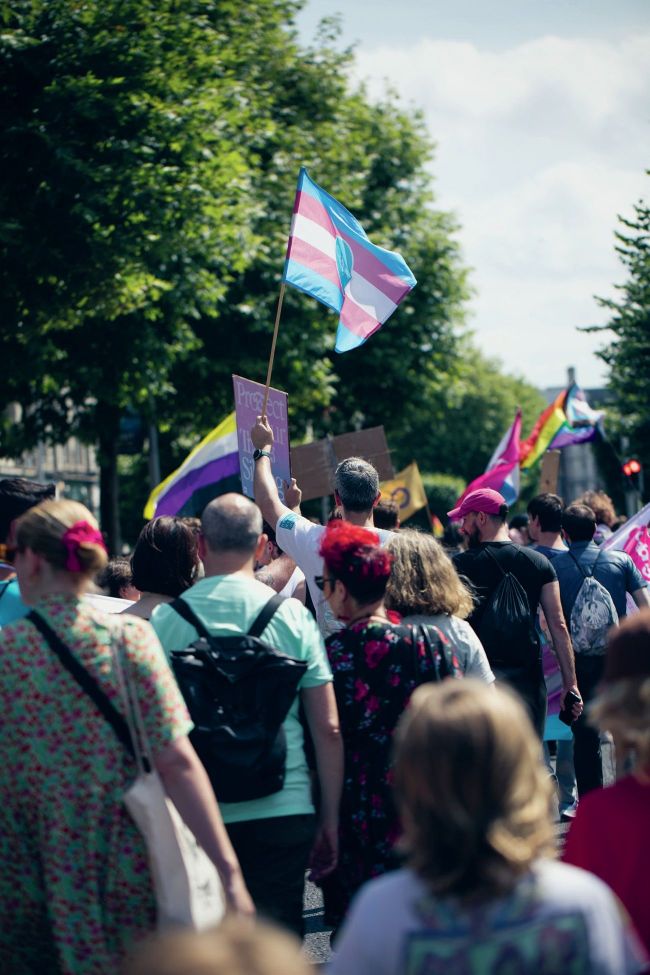
Photo by Hazel Coonagh.
The biggest reason for people voting to lift the ban on abortion was a woman’s right to choose. Trans & Intersex Pride Dublin was founded by activists who were active in the Repeal campaign. In 2018, our theme was ‘Bodily Autonomy’, directly linking the win for abortion rights to the need for trans and intersex people to have agency over their own bodies too.
When we first started, we were called Trans Pride Dublin, yet we made a conscious point to include intersex people and liberation. Even though being intersex and trans aren’t the same thing and we may face different struggles, we wanted to make our stance on bodily autonomy clear.
Intersex people continue to face stigma and discrimination in Ireland and globally. One of our core demands has always been an end to Intersex Genital Mutilation (IGM). Countries like Malta, Greece and Spain have banned these invasive, nonconsensual practices, Ireland needs to step up and be next. Intersex people should be empowered to make their own decisions over their own bodies and have full access to their medical records and history. Oftentimes, people aren’t even told they’re intersex, which increases shame and stigma.
Intersex people in Ireland face significant mental health difficulties, according to a Being LGBTQI+ in Ireland subreport. Participants stated these mental health challenges had less to do with being intersex and more to do with how other people reacted to their disclosure. Our binary ideas of sex and gender, as well as a lack of understanding around the topic, actively harm and isolate intersex people.
Both intersex and trans communities are harmed by gender norms and the gender binary. We changed our name to Trans & Intersex Pride Dublin to acknowledge that intersex people are an active part of the overall struggle for bodily autonomy. We would encourage anyone to support Intersex Ireland, the only intersex-focused organisation in the country.
Healthcare continues to be one of the most pressing issues facing trans people in Ireland. Back in 2018, we were talking about how the waiting list for the National Gender Service (NGS) was four years long. Now, anyone who is referred to the NGS could be expected to wait up to 18 years for their first appointment.
When the NGS threatened to close their waiting list to new referrals, they cited it was due to a “lack of resources”. The NGS will try to put the blame onto trans folks, say that the waiting list is due to an influx of people coming out and seeking HRT. Of course with increased visibility more people have come out as trans, but this is not why the waiting list is so long. The waiting list is just the tip of the iceberg when it comes to the rotten system of trans healthcare in Ireland. Having one clinic for every trans person in Ireland creates a bottleneck system where every individual who wants to medically transition is forced to go through the NGS. The model of care also doesn’t help. Trans people are pathologised and treated as either a fetish or mentally ill.
Trans people have been shouting from the rooftops for years about the inherent flaws within the NGS, about how we’re interrogated for hours on end about our relationships, our sex lives, our trauma. The NGS is not there to help trans people medically transition, it is there to prevent and gatekeep healthcare from us. They will look for any reason to deny a trans person HRT – people have been denied or delayed treatment for being neurodivergent, not being out to their families, being on social welfare or not conforming 100% to gender norms. Trans people are often accused of reinforcing gender stereotypes when it is actually transphobic doctors who hold us to a higher standard of conformity than cisgender people.
The NGS wants to have a monopoly over trans people’s healthcare, going as far as threatening GPs who are supporting patients in accessing private care or blocking GPs from performing routine blood tests to those who are self-medicating or DIYing HRT. If they truly cared about the trans community, if they really did feel like there was a lack of resources, they wouldn’t be sending letters to supportive GPs who are treating patients with no other options. DIY HRT is a reality for trans people in Ireland, just like how many women and pregnant people took abortion pills (and many still are) when abortion was banned in Ireland. You can’t ban abortion and you can’t prevent trans people from medically transitioning, you can only drive it underground.
What we want is not more NGS-style gender clinics in Ireland, we want to abolish the NGS in favour of an informed consent-based model where a trans person can go to their GP and be prescribed HRT. GPs already prescribe the same medication to cisgender people. By pushing trans healthcare to separate clinics, it only increases the stigma associated with the community. Our healthcare isn’t specialised, it’s just healthcare.
The NGS isn’t the only healthcare service with issues. The HSE is not fit for purpose as a result of years of austerity and budget cuts. There are no public options for neurodivergent adults to get a diagnosis of autism, ADHD, dyspraxia, and more, forcing many to pay hundreds to go private. Endometriosis care is non-existent with many forced abroad to seek treatment or surgery. It could take a decade or more to even get a diagnosis.
Disabled people have to fight tooth and nail for basic healthcare. Disability Allowance is barely enough for the average disabled person to get by, and that’s not taking into account the hidden costs associated with disability. The most glaring example of the poor care disabled people face is how Harvey Morrison, a child with spina bifida and scoliosis, was treated. Harvey was only nine years old when he died after waiting several years for spinal surgery. He was completely abandoned by local disability services. His parents, Gillian Sherratt and Stephen Morrison, continue to do Trojan work for disabled children to ensure history doesn’t repeat itself with others like Harvey.
It is not only people accessing care who are victims, it is also the workers who bear the brunt of a crumbling public health system. The Irish Nurses and Midwives Organisation’s 2026 survey found that 80 per cent reported unsafe staffing levels, with many feeling pressured to work additional hours and shifts. Healthcare workers are battling burnout and stress because no real investment is put into the system. Migrant healthcare workers especially are holding our healthcare system together, often while facing racist violence.
All this is to say in order to have trans healthcare that is fully accessible, based on bodily autonomy and informed consent, we need real investment in our public healthcare. Our fight for bodily autonomy is inherently linked to a broader struggle for everyone to have real access to these services. We can’t fight for trans rights completely isolated from the other campaigns and protests taking place in Ireland.
Despite never having corporate sponsorships, Trans & Intersex Pride Dublin has continued to grow year after year. In 2025, 10,000 people marched for trans and intersex liberation, at a time when we are seeing massive backlash against the two communities. There are always alternatives to corporations. LGBTQ+ organisations have been a huge help to us, but even in our first year we had solidarity from the National Animal Rights Association (NARA), the Irish Anti-War movement, FORSA youth, and more.
Unite the Union paid for our posters the first year too, and the group has continued to actively support us, including their construction branch donating €400 to us in 2022. In an industry that is usually considered to be quite masculine, this kind of solidarity speaks volumes to the support Trans & Intersex Pride Dublin gets. Solidarity can be found in places you wouldn’t expect.
But it’s ordinary people too. Trans and intersex people are more likely to be unemployed, underpaid, or in precarious employment. The cost of living crisis hits marginalised communities the hardest. Yet, even when people are struggling to get by, they still manage to donate a tenner, a fiver, two euros, a couple of cents to our cause. All those small donations add up and mean that we are able to organise a march every year. They mean we can still continue to be openly anti-capitalist and radical, where we’re not forced to water down our politics in order to apply for grants.
It is ordinary people, not politicians or governments, that will free us from the oppressive chains placed on us by capitalism.
On July 11, Trans & Intersex Pride Dublin will take to the streets again. Join us in the struggle for true liberation for all.
Stay up to date with Trans & Intersex Pride Dublin on Instagram @transpridedublin.