A NEW APPROACH
Following the liquidation of the company behind Cork Pride in 2025, a community group, Cork Community Pride, emerged to take the reins, centring grassroots organising and a community-based approach. Sarah Fitz spoke to one of the organisers, Niamh Kennedy, to hear about the plans for this year’s festival.
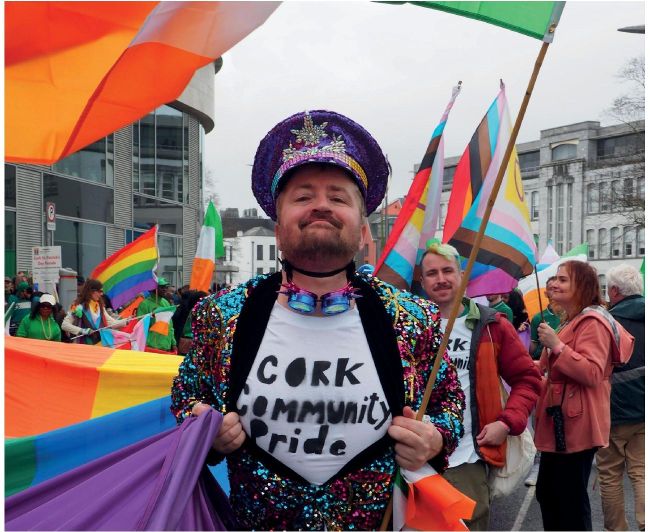
Photo by Alex Fuertes Roper
At the beginning of 2026, a newly formed group, Cork Community Pride, announced its plans for the return of the Cork Pride festival this August. Taking on board the organisation of one of the biggest Pride events in Ireland was no mean feat for the volunteer group.
When Cork LGBT+ Pride CLG dissolved in 2025, community advocacy groups came together to ensure the festival could continue into 2026. In January of this year, a public consultation meeting was held, organised by LINQ Ireland, Gay Project, and Gender Rebels, bringing together the local LGBTQ+ community to discuss the future of Pride in Cork.
“There was a huge emphasis on steering away from international corporate sponsorships, and having a not-for-profit ethos and a volunteer-based approach with no centralisation of power,” said Niamh Kennedy, Chair of
Cork Community Pride’s new steering committee.
The public consultation meeting led to 50 volunteer sign-ups, which formed the basis for the new group’s planning process. With a wide range of volunteers across age groups, backgrounds, and locations throughout
Cork city and county, the common value is “a drive and a passion to fill the streets with colour and culture on the August bank holiday,” says Niamh.
Speaking about the mission of the new community-led group, Niamh highlighted the importance of centring local performers and activists. There is a mission to return to the roots of Pride, and while the main goal this year is to run the Pride march and Pride Family Picnic, the group is also prioritising a Cork community focus and a commitment to ethical sponsorship.
“Our unofficial tagline at the moment is: we’re here, we’re queer, and we’re volunteers,” notes Niamh.
Focusing on the festival itself, it’s full steam ahead for the August weekend. The celebrations will kick off on Saturday, August 1, with the Pride Family Picnic in Fitzgerald’s Park. With community stalls, live performances, and guest speakers, the event is set to be a wholesome, family-oriented extravaganza.
On Sunday, August 2, the Pride march will run through the streets of Cork city, with a brand-new route this year. Previously, the parade had finished along Kennedy Quay, but this year it will both start and finish on Cork’s Grand Parade. Niamh mentions the importance of centrality and accessibility in Cork Community Pride’s programming, keeping all members included in the planning process. The new route will allow people to absorb the atmosphere without having to follow the parade down to the quays, ensuring that “people don’t feel like they’re missing out, that’s the benefit of having the starting point the same place as the endpoint,” explains Niamh.
As well as the weekend itself, the group is keen to champion other queer events taking place in the rebel county: “Alongside those two main events, we are also going to be promoting many other LGBTQ+ focused events happening in the weeks leading up to the August bank holiday. We’re focused on the parade and the picnic, but we are also devoted to uplifting other community events in Cork,” Niamh says.
Cork Community Pride hopes to, in the coming years, add more programming to the Pride schedule, collaborating with local groups to achieve this.
As a completely non-profit, volunteer group, feedback from the community is a central focus. The group recently held an update event, bringing together members of the Cork LGBTQ+ community to explain what the group has achieved since its inception in February 2026, and to take feedback and suggestions. Niamh mentions the value of this community feedback, something which can be missing from for-profit set-ups: “We’re not operating in a vacuum… everyone is a part of it, and everyone has the opportunity to be a part of it.” The feedback loop is essential in creating a sustainable approach to organising Pride.
The reception from the Cork community has been astonishing. Local LGBTQ+ groups, such as SAINTS drag house, have organised their own community fundraisers for Cork Community Pride. The organisation itself has hosted coffee morning fundraisers, a Big Gay Pub Quiz, and more, noting “the generosity of people, when you’re open and transparent with people, they are willing to feed into it and contribute as well.” Niamh says they aren’t surprised by the level of support, remembering the original public consultation in January, where people were “fired up about making Pride something that everybody could enjoy and feel like they could believe in”.
When asked about their hopes for the future of Cork Pride, Niamh mentions sustaining consistency and maintaining the volunteer structure of the group. They would love to see a larger programme in the upcoming years, with a week-long Pride festival including workshops with activists and collaborative events with other local groups. They believe that, with more time to plan and more funding to support the grassroots ethos, these can be achieved in future iterations of Cork Pride.
The theme for Cork Pride 2026 is ‘celebrating the past and fighting for our future’. The grand marshals “are all community members who have contributed to the LGBTQ+ community in Cork through the decades and have been activists their whole lives,” says Niamh. Cork Community Pride, in its first year organising the festival, wanted to be represented by the people who have built the foundations for Pride, and who are central to reclaiming Pride as a protest. Rather than having just one grand marshal, the group is centring the community spirit necessary for Pride. Niamh is looking forward to “acknowledging how far we’ve come, going back to our roots, and focusing on community engagement and uplifting the community”.
As a grassroots organisation, achieving a festival of this size demonstrates the scale of what can be done with a volunteer group and a positive, community-oriented approach. Niamh hopes that this event can show people what’s possible when volunteers come together and give their time and effort to something mutually beneficial and rewarding. It symbolises the ethos of the queer community.
The Cork Community Pride group is not-for-profit, and through its ground-up approach to organising, it steps away from any rainbow washing or disconnect from the community. People have a chance to directly get involved and have their say, which is empowering in and of itself. Another benefit of a volunteer-based structure is that people can give of their time without pressure, contributing as much or as little as they have the capacity for. With students, seasoned activists, and those involved in local LGBTQ+ groups, there is a wide range of people on board, with a focus on bringing each member’s skills to the fore. “I think having one of the leading LGBTQ+ events of the year in Cork being community and volunteer-led shows the overall ethos of queerness in Cork city,” concludes Niamh.
Cork Community Pride 2026 takes place on August 1 and 2. For those who wish to support and get involved, a volunteer form is linked in the group’s Instagram bio, @corkcommunitypride. As well as this, the Instagram page will be a hub of activity for details about the festival itself, and all the fundraisers in the run-up, including an event in The Pav on June 21, with local performers and drag artists. On the group’s website, corkcommunitypride.ie, you can also find listings on the events calendar page.
This article is part of GCN’s new Amach le Bród (Out with Pride) series, to combat anti-LGBTQ+ misinformation and platform underrepresented voices. The project was funded by the Coimisiún na Meán News Reporting Scheme.