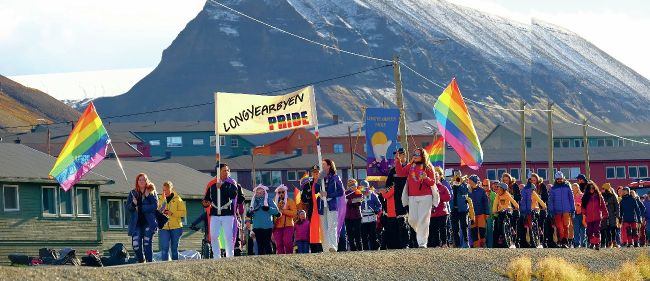
Photo by Håkon Daae Brensholm/Snyfoto.
Lene Jeane tte Dyngeland never expected to start a Pride festival. In 2019, she was in her third year of living in Longyearbyen, the largest settlement on Spitsbergen, part of the Svalbard archipelago. Originally from Bergen, she arrived “for a short vacation”. Within two days, she had secured a job with Svalbard Adventures, ferrying tourists across this vast, unspoiled Arctic wilderness.
“I have been here ever since,” she tells GCN.
Most will never have heard of Longyearbyen. At 78 degrees north, it sits halfway between mainland Norway and the North Pole, making it the world’s northernmost permanent settlement. Though Svalbard spans an area only slightly smaller than Ireland, fewer than 3,000 people live across its scattered settlements.
For many, Svalbard is better known through fiction than experience. My first introduction to the place was through Philip Pullman’s His Dark Materials series, where it is home to witches and armoured bears. When I visited in 2024, there were no airships or ‘panserbjørne’ to contend with, but that sense of otherworldliness, of life existing on the very edge of civilisation, was unlike anything I’d experienced before.
Life here comes with particular rules. Cats are banned to protect the delicate ecosystem of migrating seabirds. Here, anyone can live and work visa-free if their home country is one of the 49 signatories of the Svalbard Treaty. It’s commonly said that it is illegal to die on Svalbard. Not true, of course, but you cannot be buried here as the permafrost is frozen to a depth of 50 metres. Trees cannot grow for the same reason, though you will see huskies everywhere you go; there is even a popular husky café. At the edge of the settlement, signs warn of the presence of polar bears, known as “the kings of the Arctic”, and anyone leaving town must carry a rifle for protection.
It was while reading a copy of Svalbardposten in front of a roaring fire at the Svalbard Hotell Polfareren (the name translates to ‘Polar Explorer’) that I first learned of Longyearbyen Pride. Though I’d missed it by two months, the idea that Pride could flourish in one of the most remote and least hospitable places on the planet fascinated me. I was determined to learn how it was put together.
From early April until late August, the town basks under the Midnight Sun, where daylight never fades. When the sun finally sets on November 14, it will not rise again until February. This is the Polar Night, referred to by locals as the “dark season”, when Longyearbyen’s iconic ‘spisshusa’ – the colourful houses at the edge of town – are lit only by the moon, the stars, and the occasional flicker of the aurora borealis.
Against this dramatic backdrop, Dyngeland began putting handmade posters all over town, inviting people to take part in a new celebration; Longyearbyen Pride was born.
“I haven’t noticed anything here in Longyearbyen that discriminates by sexuality,” she told the crowd of almost 600 people who turned up in bright colours that day, carrying Pride flags as they marched from the village’s school hall to the Radisson Blu Polar Hotel. “But we have to remember that the world is a big place.”
Among the marchers were Svalbard’s governor (known as the ‘Sysselmann’), police leaders, firefighters, teachers, and families. Also present was the village priest, Siv Limstrand, who has been active in the Pride movement in her native Trondheim for over 25 years. As the parade came to an end, a rare Longyearbyen rainbow appeared overhead.
While everything went to plan, organising Svalbard’s first Pride demanded significant time and energy. At the time, Dyngeland had just started her own business – an artist’s studio in nearby Nybyen catering to those unable to take part in Svalbard’s more physically demanding activities. For the first four years, she paid for everything out of her own pocket; eventually, community funding eased some of the financial strain. What began as a small celebration has since grown into a three-day festival, with a free cinema, children’s activities, church ceremonies, and even a Pride cruise around Svalbard’s fjords.
That vision of inclusion in the High Arctic is reflected in Norway’s broader approach to LGBTQ+ rights. On the 2026 ILGA-Europe Rainbow Europe map, which ranks 49 countries on their legal and policy frameworks for LGBTQ+ people, Norway ranked eighth.
In 1981, Norway was the first country to enact a law prohibiting discrimination on the basis of sexual orientation. Same-sex marriage has been legal since 2009, and couples enjoy equal rights in areas including adoption and church weddings. As of 2016, legal gender can be changed without medical intervention. So-called ‘conversion therapy’ was outlawed in 2024. LGBTQ+ people can serve openly in the armed forces, and it is one of the few countries to explicitly protect intersex people from discrimination. Proposals have also been put forward to fast-track visa applications for trans people fleeing persecution in the United States.
In 2016, in a speech at the Royal Palace in Oslo, King Harald V put it simply when he said: “Norwegians are girls who love girls, boys who love boys, and girls and boys who love each other.”
While Dyngeland’s business did not survive the financial pressures of the pandemic, Longyearbyen Pride continued every year. Svalbard’s seclusion and the collapse of global tourism meant that the locals could continue celebrating while many Pride events elsewhere were put on hold.
In 2024, Dyngeland announced she would be stepping down, describing herself as “burnt out” after years of organising the festival.
“I did it alone. No help, no volunteers,” she says. “This was my baby.” Others have since taken her place. While she is no longer involved in the day-to-day running of Longyearbyen Pride, Dyngeland hopes to attend this year’s festivities.
“I started this because I wanted to create a festival that included children,” she explains. “It was important for me that kids and young people were at the centre. We dress up in bright colours with face paint, we wave flags, we sing, and we have speeches by adults and youths. It’s meant to be inclusive, free for all, and to show our kids that they are free to love who they want.”
But in Longyearbyen, a town defined by extremes, the rhythms of life are beginning to shift. Temperatures here have risen by 4°C since 1971, five times faster than the global average. Nowhere on the planet is warming more rapidly.
Svalbard may feel like a raw, primaeval landscape, but what is happening here is a microcosm of the broader climate crisis. Based on current trends, it could see up to 10°C of warming by 2100. The glaciers that cover around 60% of the archipelago are in terminal decline, and the sea ice that was once frozen solid against the island has retreated dramatically. What was unthinkable just a few decades ago has become a stark and frightening reality.
The consequences are already being felt. In Longyearbyen, avalanches have claimed lives and destroyed homes, even as tens of thousands of tourists – each producing enough CO2 emissions to melt a square metre of sea ice – continue to arrive each year.
In her book My World is Melting: Living with Climate Change in Svalbard, the Norwegian journalist and editor of Svalbardposten, Line Nagell Ylvisåker, writes: “Nature in Svalbard has always been wild, beautiful and unpredictable. The unaccommodating terrain has accounted for many lives [lost]: people have fallen down crevasses, plunged through the ice, been hit by avalanches, have frozen to death, have drowned, and have been attacked by polar bears.”
Nevertheless, this “harsh but stunning wilderness” drew her in, just as it has drawn in countless others, myself included.
“I can walk outside and see belugas in the fjord, northern fulmars following a boat’s slipstream, guillemots diving as we get closer, and puffins paddling across the water. This is the beauty of Svalbard life,” she writes. What will happen to Svalbard and the wider world when the ice is gone? In a place where everything is shifting, including the ground itself, the act of gathering and celebrating Pride takes on a different kind of weight. In Longyearbyen, that spirit persists. It continues to bring people together, even as the landscape around them changes.
For more about Longyearbyen Pride, visit longyearbyenpride.no and @longyearbyenpride on Instagram.