Meditations on labour
Richard Malone is an Irish artist whose work traverses sculpture, textiles, performance, and installation.
Shanaia Kapoor sat down with the Wexford-native to discuss everything from queerness to class, and the crux of meaning-making when you’re good with your hands.
R ichard’s practice interrogates gender, class, and identity through labour-intensive techniques, bringing attention to histories and practices often absent from museum collections. They have exhibited globally, including at MoMA and the MET in New York, the Royal Academy in London, and MoMU Antwerp, and have been commissioned for major institutional projects. Their writing, published in British Vogue, Luncheon, and Erotic Review, reflects a practice in which making and thinking are inseparable.
Richard is currently home in Wexford, so we speak over Zoom. I imagine they’re somewhere familiar. It’s the beginning of an Irish summer. We wave through the sunshine and introduce ourselves, presuming our acquaintance will be brief. Over the next hour, however, through some fairly long-winded questions, I come to know Richard as I would a new friend in the smoking room, like “Can I borrow a light?” except I’m picking their brain for some long-due respite amidst all the slop.
Richard is often based in Wexford. “A lot of the sculpture work is easier to make here because I have access to a welder and there’s more space.” It’s nice, they say, being back and ‘making’ in a rural setting. Everything in their practice — welding, painting, plasterwork, stitching, sewing — they learned from their grandmother, a hospital seamstress, and their father, a painter and decorator, all trades that continue to be present in Wexford today.
Home threads through all of Richard’s work without tipping into nostalgia. “Historically, I don’t come from a type of people whose work would be considered valuable,” they say, “so there’s an effort to make that really visible in anything I make.” They grew up with fixed ideas of Ireland being pushed at them, especially rural Ireland, the version that is quaint and quite Catholic. “When you grow up like that, people become fearful of the ‘other’, and being the ‘other’ is even worse.” Identity becomes enormously important when you come from a people colonised and overlooked for so long, but, they say, “I always feel like I have to reimagine it.”
Born in 1990, when being gay was still illegal in Ireland, Malone grew up as the country emerged from a violent past. Their work now reimagines the contexts in which it can exist, using their body as the primary tool. “I don’t know if I would’ve been able to make the work I make without the political changes Ireland has gone through. As my work grows, it’s about reimagining the context that it can exist in and how far it can be pushed.”
For Richard, bodies, labour, and identity are inseparable. Their practice brings together physical processes like welding and stitching, forms of labour that carry very different social histories. I ask if the contrast between softness and structure is a conscious choice. “Yeah, I think I struggle to understand what bits of my practice are conscious or unconscious,” they admit. “I think because of the history of queer identity, queer people have not necessarily been allowed to always be abstract or thoughtful. We’ve had to participate with our bodies in a way that’s really not abstract.” They reflect on the idea that something can be fragile. And it can also change. The idea that the work can change.
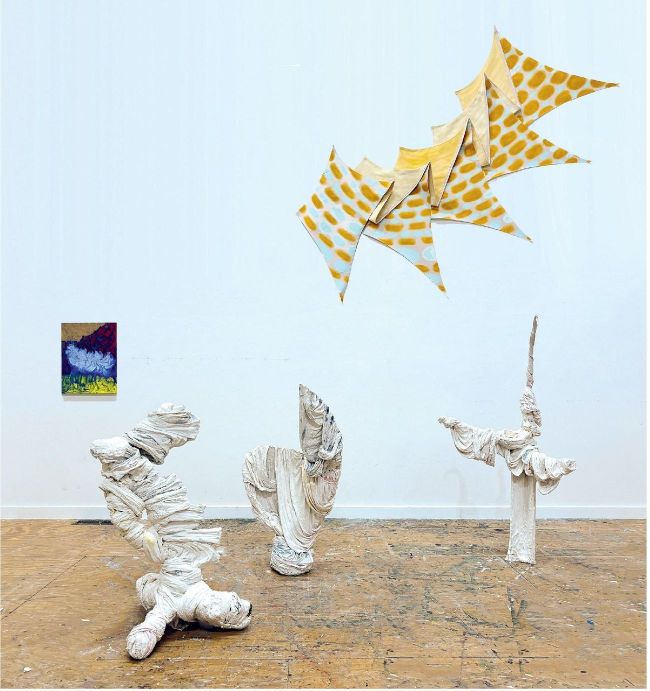
“I think labour carries such a specific connotation of class. And within that context are also the connotations of gender.” They recall the men working in factories as being quite reserved. “There’s no emotional language for things that happen on a factory floor.” By contrast, women in the domestic spaces of Malone’s childhood, “my aunts, my cousins, my grandmother, her friends,” spoke openly about politics. “As a young queer person, overhearing these conversations about divorce or the Marriage Referendum, the kitchen was an extraordinarily safe space. Gender didn’t dictate the ways you could engage.” It is precisely from this duality, between the reserved and the expressive, that Malone’s work emerges. “More than tension, I’m interested in the middle ground where something is not one thing or the other,” they say.
The closer Richard moves toward institutional spaces, the more sharply they seem to perceive the gaps within them. At the British School at Rome, they were brought into conversation with doctoral candidates from Oxford and Cambridge. “My questions were always just so different,” Richard recalls. “They’d say, ‘Well, this emperor was a patron,’ and I would respond, ‘But that’s not who built it, who was the person who built it?’” Richard fixes their hair, looking out of what I presume to be a window. “I see so many gaps. And the closer I am to those conversations in museums or places where serious cultural decisions get made, I’m immediately like, ‘Where are the queer people? Where are the working class people?’”
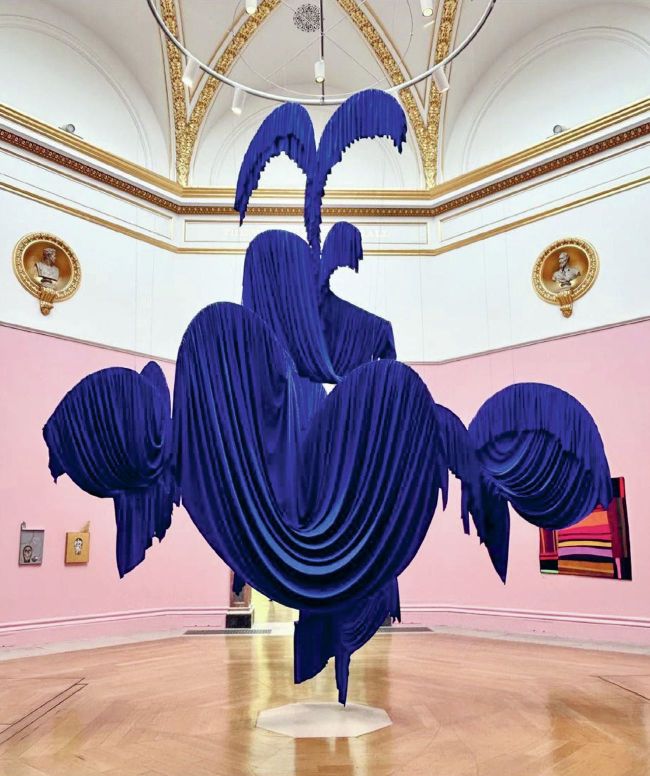
Malone was commissioned by the Royal Academy of Arts in London to create the Central Hall commission for their Summer Exhibition in 2023, showcasing a large-scale hanging sculpture, ‘poem in the dark about sadness/ filíocht faoi bhrón, as an dorchadas’ (above, left). It was the first time an Irish person had received that commission.
“I was super young and I never thought gender was that much a part of my work. But it’s a really big part of how I consider myself and question the world,” they say. Being in the beacon of art making in England, Malone notes, “It was so fascinating to observe all the female Royal Academicians being so friendly, ‘Oh, this is so exciting for us to see this massive sculpture in the middle of the room,’ while the male RAs were like, ‘Well, what is it?’ It seemed like such a threat to them. Something soft, suspended, constantly moving, refusing to reveal a front or a back or a side. Resisting what I’d call a product-y idea of art.”
When asked about the future of arts in Ireland, Richard says, “I think the next generation of artists may well be Irish, but they probably won’t be working and making in Ireland. Nothing would make me pay what it costs to live in Dublin. Which is sad because when I did a residency at the National Gallery and lived by Stephen’s Green, I thought, this could be hands down the best city. The people are amazing, everyone’s enthusiastic, 10 minutes and you see everyone you know. It’s really an infrastructure problem.
“I think class is a major barrier that nobody wants to talk about,” Richard continues. “Whenever I worked in museums in Ireland, people would say, ‘Oh, you’re from down the country,’ but I was like, ‘Your accents are actually really aggressive to me. You’re all talking to each other about a housing crisis that none of you are affected by. Like, you’re living in your mum’s house in Donnybrook.’ I’m like, is this bull? Ireland is quite left-leaning, but nobody wants to give up their spot. I’d happily advocate for grants and awards to be means-tested, and by means I’m talking also about what you stand to inherit, where you live, how you access money, how you make your work. People find that really uncomfortable.”
Richard and I kiki about the rental hellscape since the weather provides no grounds for complaint. “The Basic Income for the Arts came from a real need and years of research, but now it’s being implemented in a completely different country with completely different costs. Dublin has become unliveable. People aren’t asking for anything radical. Renovate the empty spaces above shops, make flats, make them affordable. The most rewarding exhibitions I’ve done have actually been outside Dublin, in places like Limerick and Leitrim, where people were just like, ‘f *ck it, do whatever you want, we’re here to support you.’ I owe a lot of that to Mary Conlon and Linda Shevlin who I worked with for my show at the Dock. There’s this assumption that radical work won’t connect outside Dublin, but honestly Dublin can be a conservative place sometimes.”
The preservation and reinvention of craft becomes more valuable when they’re in conflict with each other, “Here’s what it used to be, and here’s what it can become… Pre-colonisation Ireland was a matriarchal culture where power was handed down from woman to woman. And when I look at Irish art now, so many of the most brilliant artists are women, especially sculptors. Artists like Alice Maher, Dorothy Cross, Eileen Gray, Kathy Prendergast, Niamh O’Malley, Aleana Egan and Aideen Barry. They’re unbelievably brilliant thinkers who’ve reinvented craft and material in really political and sincere ways. By making their work, thinking differently, they opened the door for me to think differently too, or not to be afraid of a singular approach. I think they’re really instrumental in how they’ve rethought making, and seeing work like that is always an invitation to find your own language.”
I have to ask about their collaboration with Björk. “I’d done commissions with a lot of famous musicians,” Malone says, “but she’s the one that’s really significant to me. Her song ‘It’s Oh So Quiet’ – I think it was the first song I remember loving. I’ve never actually got to tell her that, but when we met, we had loads of similar interests.”
They reflect on the collaboration: “With Björk, it’s a sincerity thing. Sincerity has become almost icky now, but she’s really polite, loving, sensitive about things.”
Malone continues, describing the projects they made together – the album pieces, music videos, even her 50th birthday commission. “She was saying how Viking women escaped ships from Ireland to Iceland, and how music scores feel really similar between the two countries. Collaborating with her doesn’t feel like there’s any limit or expectation. I feel mad to be part of that family in some way.”
Our conversation ends here. Richard congratulates me on my graduation from Ivory Tower University, and we wave goodbye as the sun sets outside our windows. I shut my laptop and put on Björk’s ‘Venus as a Boy’ thinking maybe good art is only made when sincerity survives the process. My sense is Richard knows this well.