Fantasy ball
Cork’s Fantasy Ball is preparing to make a highly anticipated return this November, promising sapphic debauchery, dancing and memories of nights gone by. Ahead of the occasion, Val DeBarra traces the history of the iconic event and teases what’s to come.
For more than two decades, Cork’s Fantasy Ball gave people permission to take an idea and run with it. To be ridiculous, elaborate, sexy, political and surreal. To spend weeks constructing something extraordinary or arrive with an idea held together by whatever was available five minutes before leaving the house. There were themes, certainly. Rules were another matter.
This year, after a long hiatus, the Fantasy Ball is coming back. On Friday, November 13, The Pav will host ‘Evolutions//Revolutions’, the first Fantasy Ball in many years and the latest chapter in an event woven through Cork’s lesbian and dyke community for more than three decades. For some people walking through the doors, it will be a return. For others, it will be the first time they get to see what everyone has been talking about.
The first Fantasy Ball took place in 1994, organised by Emma Bidwell and Ger McCarthy. Its theme was ‘Pandora’s Box’, or, in full, ‘Pandora’s Box: a Lesbian Camp Drag Fantasy Cabaret Ball’. It was held at Blackrock Castle on November 19.
Orla Egan remembers arriving at the castle that night and seeing the courtyard full of lesbians dressed in all kinds of finery: “It was a stunning and powerful display of queer sexuality and playfulness,” she says. People who usually wore Levi 501s and ironed white shirts had turned up in short, clingy dresses and stockings. There were uniforms, barely-there outfits and people playing with gender presentation in ways that were rare at the time. The room pulsed with overt queer desire and celebration.”
That description tells us something important about the Fantasy Ball. It was spectacular, certainly, but the spectacle was not the whole point.
When the first Fantasy Ball took place in 1994, LGBTQ+ life in Ireland looked very different to what it does now. Homosexuality had only been decriminalised the previous year, and same-sex relationships had almost no legal recognition. Dedicated spaces mattered enormously. Community was built through activism and organisations, but also through the places where people could meet, dance, flirt, organise and feel part of something. Some of that happened through helplines and newsletters. Some of it happened in pubs, community centres, kitchens and nightclubs. Some of it happened while dressed as Sappho at the Fantasy Ball in Cork.
Emma Bidwell later described the ball as “the Irish lesbian scene and herstory in miniature”, full of people who were still finding the nerve to be what they wanted to be, alongside those already pushing at the limits of what was acceptable. That was part of what made the night powerful. The costumes created a kind of permission. To exaggerate and experiment. To play with gender, sexuality and desire. To wear something that ordinary life did not make room for.
By 1996, Inside Out, a community newsletter in Cork, featured an advert for the ball, describing it as “A Time For Lesbians to Unleash Their Desires (Or At Least Wear A Silly Costume)”. The report from the same publication for that ball gives a sense of the scene: a space chick passing a cocktail to the Ice Queen, a demon encountering an Amazon and Marilyn Monroe sharing the bar with a buccaneer. There was a makeup room stocked with safe sex packs and emergency sewing supplies. The evening, the report said, became a “rampant night”.
There is something joyous about the absurdity of that description, but reducing the Fantasy Ball to a very committed fancy dress party misses something about why people still talk about it.
Presenting in 2000 at the Lesbian Lives Conference, Orla Egan described the ball as a space where lesbians could “express and explore and play with our fantasies” at a time when these opportunities were limited.
The event continued in different forms for more than 20 years. Kate Brennan Harding, who organised both the Fantasy Ball and its sister creation Dangerous Liaisons, remembers that period as “a beautiful celebration of lesbian wlw (women-loving-women) energy”, full of flirtation, fantasy and a sense of honouring community.
Writer Ger Moane remembers the same combination of freedom and possibility: “Wild, dynamic, fun, sexy, it gave our imaginations and our desires free rein”. It was also where she and her future wife Sonya fell in love. That detail seems as important as any poster or photograph in an archive.
Queer history is preserved in legislation, campaigns and moments of public protest, but it also survives in the stories people tell each other. Who was there. Who wore what. Who fancied whom. Who organised it. Who fell in love. Who stayed until the lights came on.
Watching Cara Holmes’ Lesbian Lines this year, what struck me most was not simply the extraordinary history being preserved on screen. It was the people sitting around me. Dykes of different ages, some of whom had lived the history we were watching and others who had inherited its consequences without necessarily knowing the names of the people who had created it. There is something powerful about the moment when queer history stops feeling historical. When the people who built the spaces are still in the room.
The Fantasy Ball eventually came to an end, but people continued to talk about it. For years, there were memories, stories and occasional conversations about bringing it back. Eventually, Emma Breathnach, Robyn Penkert, Marielle Xuereb and Aly Delahan Meade decided that talking about resurrecting it was no longer enough.
When Breathnach attended a screening of Lesbian Lines at the Triskel, she found herself thinking about the same connection between generations. “Surrounded by dykes of all ages, the thread of connection was woven through time on the screen and in the room,” she says. “The draw to reconnect in dyke spaces is definitely in the ether.”
That idea runs through the revived Fantasy Ball. Its theme, ‘Evolutions//Revolutions’, is partly about resurrection: an event returning in a community that is not the same community it was when Pandora’s Box opened in 1994. It also asks what has changed, what has endured and what each generation chooses to carry forward.
For organiser Marielle Xuereb, the return also pushes against the idea that lesbian and dyke spaces are disappearing. “We’ve spent the last decade, if not longer, being told that they’re dying and fast becoming a relic,” she says. But what she sees in Cork instead is “resilience and hunger within the community”.
The Fantasy Ball was already “deep dyke lore” by the time Xuereb came out. Her first sapphic event in 2013 was itself held in homage to the ball. She remembers seeing a room full of people completely comfortable in themselves and their sexuality and feeling her mind blown.
Her generation also came of age politically around the 2015 Marriage Referendum, campaigning as college students and feeling, afterwards, that an enormous victory had been won. But history does not move neatly forward.
The past few years, Xuereb says, have been a reminder that community has to be continually built and defended. For her, that means creating something “inclusive, intergenerational and worthy of the wonderful people that are within it”.
That question of who gets to belong matters to the revived ball. The organising team describes the new Fantasy Ball as proudly lesbian, dyke and sapphic, while explicitly embracing the trans, non-binary and masc people who are part of those communities.
That is not about pretending the language of 1994 was the language of 2026. Communities change because people change them. They stretch, argue, find new words, reclaim old ones and decide what they want to carry forward. That intergenerational element may be one of the most exciting things about November’s event.
There will be people in the room who remember Pandora’s Box. Others who went to Fantasy Balls in the 2000s and 2010s and people who were too young to attend the final iteration in 2015, or who had not yet found the language they now use for themselves. They will all be arriving at the same party and, importantly, it is supposed to be a party.
Laura Lavelle will MC the evening, while West Cork all-woman band The Kates will play live. Cork’s DJ Jen will begin the second half of the night before Belfast’s DJ Katee Emm carries it into the small hours. There may be surprises too, but as ever, a sizeable portion of the entertainment will probably come from whoever walks through the door.
This year’s theme leaves plenty of room for interpretation. Evolution. Revolution. Or both. Across previous balls, people interpreted themes literally, politically, sexually, absurdly and sometimes in ways nobody but the person inside the costume could possibly explain. Perhaps that is part of why people have missed it.
Queer spaces are not important only because they offer somewhere safe to stand. The best of them offer somewhere to play. Somewhere to be louder, stranger, sexier, sillier or more experimental than everyday life allows. Somewhere that does not require you to translate yourself before entering.
The return of the Fantasy Ball is not a reenactment of 1994 or an attempt to freeze Cork’s dyke community at some supposedly perfect point in its history. It is something messier and more interesting than that. People who created the ball alongside people who kept it going. People who remember it alongside people who have only heard the stories. People using words for themselves that existed in 1994 and others using language that has emerged, evolved or been reclaimed since. A history being preserved by being used.
Emma Breathnach remembers a line from Helen Slattery in Lesbian Lines: when it comes to the Fantasy Ball, “there are no rules”. 32 years after Pandora’s Box, that may still be the best instruction available.
The Fantasy Ball: Evolutions//Revolutions takes place at The Pav in Cork on Friday, November 13, 2026. For more information, check out @thefantasyballcork on Instagram.
Read more from Val DeBarra on Substack @valdebarra.
FORWARD FACING
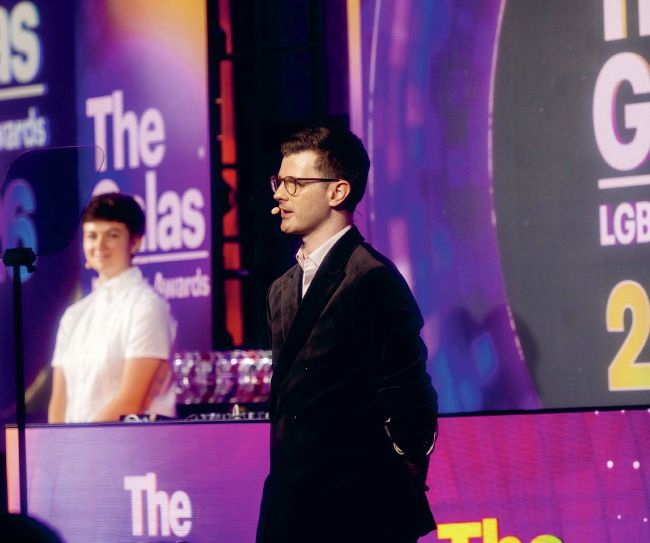
Having assumed the role of Chair of the National LGBTQ+ Federation (NXF) in August, Matt Dunne shares a message following the hugely successful GALAS 2026 ceremony. Photo by Babs Daly.
As Chair of the NXF, it was a privilege to welcome the community to the 13th annual GALAS awards. This year, we were delighted to receive a record number of individual nominations, with 2,445 submitted across all categories. I want to thank representatives from 17 LGBTQ+ and human rights organisations who worked alongside the NXF in the difficult task of narrowing those nominations down to the shortlist. With so many deserving individuals and organisations, that was no easy task.
For more than four decades, the NXF has played an important role in LGBTQ+ life in Ireland, championing equality, building community and advocating for positive change. The GALAS, established by the NXF and GCN in 2009, are a wonderful expression of that legacy, celebrating the campaigners, volunteers, artists, organisations and allies who make a real difference to LGBTQ+ lives and help create a society where everyone can belong and thrive.
Ultimately, The GALAS are about more than awards; they give us an opportunity to pause and recognise progress, to celebrate the people behind that progress, and importantly, to remind ourselves that progress should never be taken for granted. They connect the NXF’s proud history with the work happening today and with our shared ambition for an Ireland where every LGBTQ+ person can live openly, freely and without barriers.
While there is much to celebrate, we must also recognise that progress towards LGBTQ+ equality is neither inevitable nor universal. Around the world, LGBTQ+ issues are becoming increasingly polarised within political and public debate, which has real human impact.
Trans and gender-diverse people, in particular, have come under attack globally, with recognition, healthcare and inclusion increasingly under threat. Discrimination, hate speech, harassment and violence remain very real concerns for LGBTQ+ people around the world. We have recently seen the oppression of our LGBTQ+ comrades in Türkiye, where activists and community organisations are facing arrests, intimidation and an escalating crackdown on their rights. As we celebrated our community at The GALAS, we also held space for those who cannot gather openly or safely. It is an important reminder that legal rights and protections, while vitally important, are only part of the picture. True equality must be something people experience in their everyday lives, in their families, communities and workplaces.
That is why organisations such as the NXF, and occasions such as The GALAS, continue to matter. They allow us to celebrate the progress that has been made and recognise the people who have made that progress possible. They also remind us of our collective responsibility to protect that progress and to continue building a society in which every LGBTQ+ person can feel safe, valued, respected and able to be themselves. At the ceremony, many of the people helping to make that ambition a reality were in the room.
Of course, an evening like The GALAS also takes an enormous amount of work to bring together, so there are a few people I would particularly like to thank. To all of our sponsors, our event partner Catapult, the Radisson Blu, The GALAS Working Group, the GCN team, and my colleagues at the NXF board, thank you. Thank you also to everyone who joined us in making The GALAS such a special celebration of our community.
To all of our shortlisted nominees and award recipients, congratulations. Your achievements, your commitment and the difference you make are what the night is all about. And a special thank you to our wonderful hosts, Louise McSharry and Michael Fry, who guided us brilliantly through the celebrations.
As one of the NXF’s biggest fundraising opportunities in the calendar year, The GALAS goes a long way in ensuring that we can sustain GCN and other important initiatives, including the Activist Academy and the Irish Queer
Archive. We look forward to also launching the NXF’s new three-year strategy in the coming months.
To stay up to date with the NXF, visit nxf.ie.