Activism — Justice — Disregard
JUSTICE IS IN SIGHT FOR MEN CONVICTED UNDER ANTI-GAY LAWS
By Karl Hayden, a founder of the LGBT Restorative Justice Campaign
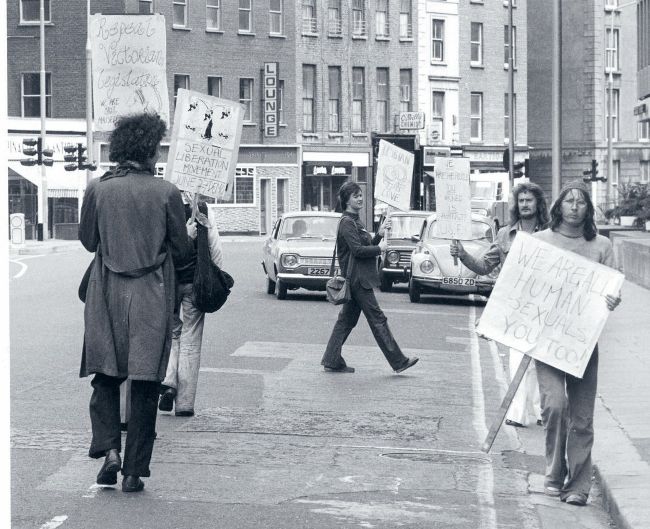
Image: Gareth Miller, Irish Queer Archive/National Library of Ireland
Intimate and loving consensual relationships between men in Ireland have been criminalised for hundreds of years. First common law, then English law, then Irish law treated gay men not as citizens but as criminals. The 1533 Buggery Act carried the death penalty. The Offences Against the Person Act of 1861 replaced this vicious penalty with ‘penal servitude for life’. An 1885 Act added new offences that criminalised intimacy between men – the law under which Oscar Wilde was convicted and sent to Reading Gaol for two years.
These laws were a violation of the human rights of gay and bisexual men and an affront to their dignity. They remained in force until they were repealed in 1993 after long campaigns and a successful European Court of Justice case by David Norris. Now, 33 years after repeal, there is some justice in sight for those men convicted under those unjust laws.
The laws inflicted enormous damage. Prosecutions became a powerful tool of social control. They were vague, allowing for broad interpretation, and its enforcement was deeply unequal, especially for working class men. Gay men were spied on, entrapped, arrested and prosecuted. Convictions carried devastating consequences: imprisonment, the loss of employment, public exposure and humiliation, family rejection, forced emigration and lifelong stigma. For many, the impact was not a moment in court, but a lifetime shaped by fear, silence and exclusion. Fear of discovery, of blackmail, of the state itself.
The harm extended far beyond those directly persecuted. Criminalisation shaped attitudes towards LGBTQ+ people and communities. It enforced silence, shame and stigma. It enabled discrimination and created a climate in which LGBTQ+ lives were treated as less worthy of dignity, protection, and respect. It spilled over into the family courts where lesbian and bisexual women could be denied custody of their children. The awful legacy of criminalisation has been felt across generations and continues to impact on lived experience today, despite repeal and other very significant legal and policy progress.
Community campaigns against criminalisation go back decades and were successful in repealing those laws in 1993, with an equal age of consent. The campaign for disregard has been underway since. The Labour Party’s Ged Nash brought a Private Members’ Bill to parliament in 2016 which was a critical turning point, initiating the process that led to the state apology in 2018. That apology, delivered in the Dáil by the then Taoiseach, Leo Varadkar, on the 25th anniversary of decriminalisation, acknowledged that the laws had caused “deep and lasting harm” and that the men affected had been “treated with profound injustice”. He reflected on how the state had not merely failed LGBTQ+ people, but had actively persecuted them, a powerful admission from a country once defined by silence on these issues.
The LGBT Restorative Justice Campaign has continued to campaign for redress, supported by key politicians, academics, historians, community organisations and civil and human rights activists and organisations here and abroad. After a public consultation process to which many LGBTQ+ organisations made submissions, a Department of Justice Working Group made 95 recommendations, including the establishment of a ‘Disregard’ scheme for past convictions between consenting adults. A ‘Disregard’ means that the person convicted of an offence is to be treated for all purposes as not having committed the offence.
The Minister for Justice recently announced that he will bring forward legislation, expected in March, to give effect to a Disregard Scheme. While we await details, we hope that it will implement the recommendations of the Working Group, including extending Disregards to convictions under similar military laws and provide for posthumous disregards.
A disregard scheme is not about rewriting history; it is about confronting it honestly. By formally disregarding convictions for consensual same-sex activity, the state recognises that these laws were wrong when enacted, wrong when enforced, and wrong in their consequences. It is a practical act of restorative justice, allowing people to live free from the legal scars of discrimination.
We hope it will bring some level of redress to those men who felt the full, brutal force of those unjust laws on their lives.
You can find out more about the work of the LGBT Restorative Justice Campaign on www.lgbtdisregard.ie. If you were prosecuted or convicted under the law, you can share your story with LGBT Disregard by writing to LGBTDisregard@gmail.com.